
Garden Gym Ideas: How to Create the Perfect Home Workout Space
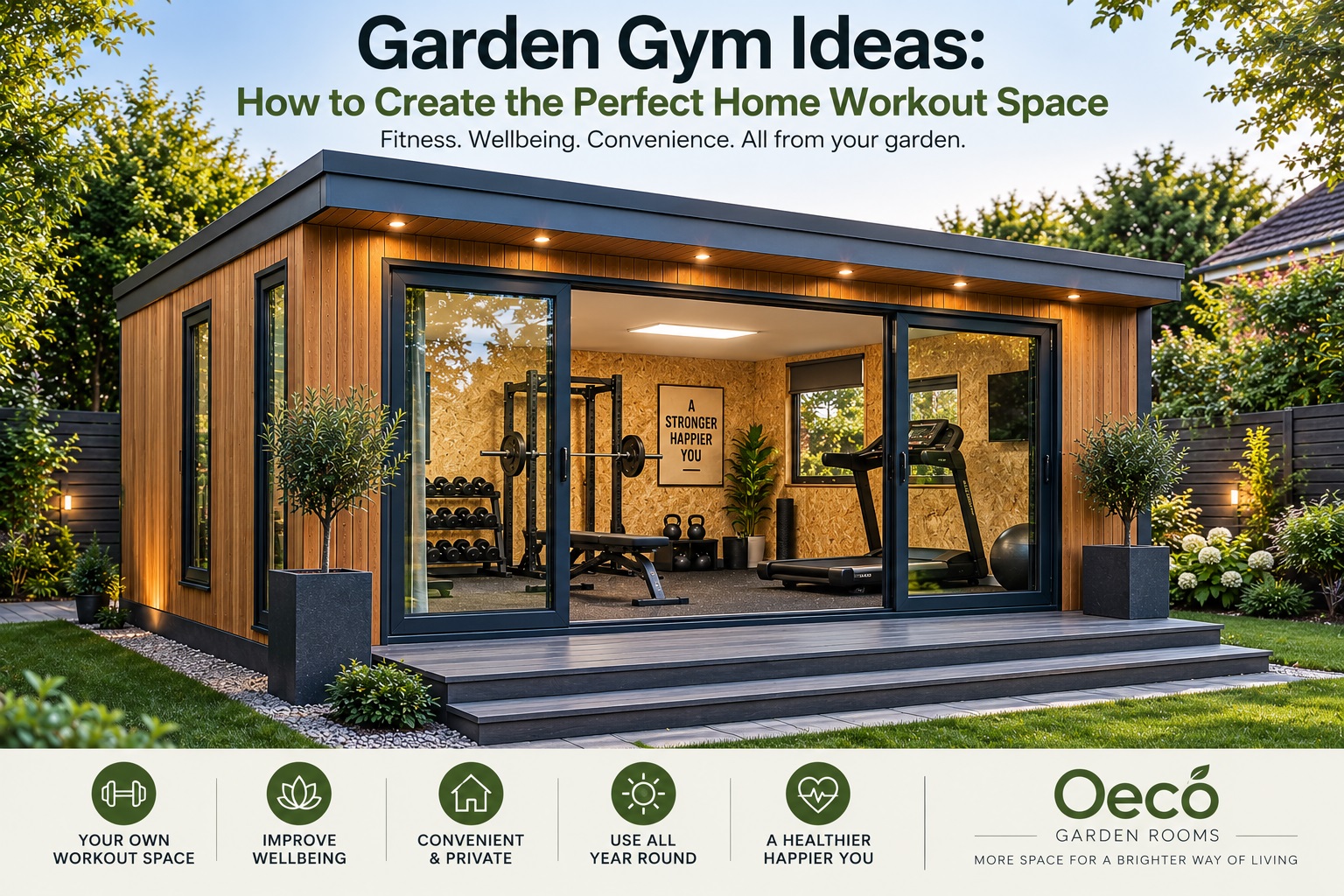
Everything You Need to Plan a Comfortable, Practical and Year-Round Garden Gym
Creating your own garden gym can transform the way you exercise at home.
Instead of travelling to a commercial gym, waiting for equipment or trying to squeeze exercise equipment into a spare bedroom, a purpose-designed garden room can give you a dedicated workout space only a few steps from your house.
A garden gym can be designed around the way you want to exercise.
You might want a treadmill and exercise bike for cardio workouts, a weight bench and dumbbells for strength training, an open floor area for yoga and stretching, or a combination of different equipment.
The important thing is to plan the room correctly from the beginning.
Size, ceiling height, flooring, insulation, ventilation, lighting, electrical sockets and equipment layout can all influence how successfully a garden room works as a home gym.
At Oeco Garden Rooms, our fully insulated garden rooms are designed for comfortable year-round use and can be configured for many different purposes, including creating a dedicated home workout space.
If you're considering turning a garden room into a gym, here are the most important things to think about.
Why Create a Garden Gym?
Convenience is one of the biggest attractions.
A conventional gym membership might involve driving, parking, changing and travelling home again. Even a relatively short journey adds time to every workout.
With a home garden gym, your workout space is already there.
That can make fitting exercise around work and family commitments considerably easier.
There is also no need to work around commercial gym opening hours.
Want to exercise before breakfast?
You can.
Prefer an evening workout?
Your gym is available.
For many homeowners, having a dedicated exercise environment also removes one of the biggest barriers to regular exercise: getting there in the first place.
A Dedicated Space for Exercise
One of the problems with exercising inside the house is that rooms usually have another purpose.
The living room contains furniture.
The spare bedroom contains a bed.
The garage may contain cars, tools and storage.
Exercise equipment often needs to be moved before and after every workout.
A garden gym solves this problem by creating a space specifically designed around exercise.
Your weights can remain on their rack.
Your exercise bike can stay where it belongs.
Yoga mats and resistance bands can have dedicated storage.
You can walk into the room and start exercising immediately.
What Size Garden Gym Do You Need?
There is no single perfect garden gym size because different types of exercise require different amounts of space.
Start by listing the equipment you genuinely expect to use.
For example:
-
Treadmill
-
Exercise bike
-
Cross trainer
-
Rowing machine
-
Weight bench
-
Squat rack
-
Dumbbell rack
-
Kettlebells
-
Exercise mat
-
Punch bag
-
Storage
Then look at the dimensions of each item.
Remember to allow working space around the equipment, not just its physical footprint.
A weight bench needs room for movement.
A treadmill needs appropriate clearance.
Free-weight exercises require enough space to move safely without hitting walls or other equipment.
Planning the equipment layout before choosing the garden room dimensions is much more effective than ordering the building first and hoping everything fits afterwards.
Small Garden Gym Ideas
You don't necessarily need a huge garden room to create a useful home gym.
A smaller room can work extremely well if you select equipment carefully.
Rather than filling it with large machines, consider compact equipment such as adjustable dumbbells, kettlebells, resistance bands, a folding bench and exercise mats.
Wall-mounted storage can help keep the floor clear.
Mirrors can also make a compact garden gym feel considerably larger.
The objective shouldn't be to recreate a commercial gym.
It should be to create a space containing the equipment you actually use.
Large Garden Gym Ideas
A larger garden room naturally provides greater flexibility.
You could divide the interior into different workout zones.
One area might contain cardio equipment.
Another could contain a squat rack and weights.
A separate open area could be used for stretching, yoga or floor exercises.
Larger garden gyms may also have room for storage, a television, seating or even a small refreshment area.
If several members of the household exercise, additional space can allow two people to work out comfortably at the same time.
Garden Gym Ceiling Height
Floor area isn't the only dimension that matters.
Ceiling height can be particularly important depending on the type of exercise and equipment.
Think about movements where your hands or equipment travel above your head.
Overhead presses, skipping and certain functional exercises require more vertical clearance than cycling on an exercise bike.
Some commercial gym equipment can also be relatively tall.
Before finalising the building specification, check the dimensions of your proposed equipment and consider the movements you'll perform.
The internal usable height is what matters – not simply the overall external height of the garden room.
Can You Put a Treadmill in a Garden Room?
A treadmill can be an excellent addition to a garden gym, provided the room is suitable for the particular machine.
Check the treadmill's dimensions and manufacturer's clearance recommendations.
Remember that the user stands above the treadmill deck, increasing the total height required.
You also need adequate space around the machine.
Electrical requirements should be considered as well.
If you already know where the treadmill will be positioned, electrical sockets can be planned accordingly, avoiding the need to trail extension cables across the floor.
Can You Put Weights in a Garden Room?
Weights can also be used in a suitably designed garden room, but the floor and equipment layout deserve careful consideration.
A rack containing substantial free weights creates a very different loading situation from a desk and office chair.
If you're planning a serious weight-training setup involving heavy racks, machines or substantial concentrated loads, discuss this during the design stage.
Don't wait until the building is completed before revealing that you intend to install an exceptionally heavy piece of commercial equipment.
Good planning allows the building specification to be considered in relation to its intended use.
The Best Flooring for a Garden Gym
Flooring is one of the most important practical choices.
A standard attractive floor may be perfectly suitable for lighter exercise, but areas containing free weights or heavy gym equipment can benefit from additional protection.
Purpose-made rubber gym flooring or protective mats can provide cushioning and help protect the finished floor beneath.
Rubber flooring can also improve grip and reduce some of the noise associated with equipment.
You don't necessarily need to cover every part of the garden room in thick gym flooring.
Protective flooring can sometimes be concentrated in the free-weight or equipment areas while another finish is retained elsewhere.
The best solution depends on how intensively the gym will be used.
Insulation Is Essential for a Year-Round Garden Gym
A garden gym should be comfortable in January as well as July if you want to use it consistently throughout the year.
That makes insulation extremely important.
An uninsulated garden building can become very cold during winter and excessively uncomfortable during temperature extremes.
A properly insulated garden room helps create a much more stable internal environment.
At Oeco, our garden rooms feature fully insulated walls, roof and floor, helping create a space designed for regular year-round use.
Insulation also works together with suitable glazing, heating and ventilation.
The objective is to create a genuine room for exercise rather than simply putting gym equipment inside a garden shed.
Garden Gym Ventilation
Exercise produces heat and moisture.
That makes garden gym ventilation particularly important.
A room that feels comfortable when empty can quickly become warm and humid during an intensive workout.
Opening windows can provide useful natural ventilation.
Large doors can also be opened during suitable weather conditions.
Depending on the size of the room, number of users and intensity of exercise, additional ventilation may be worth considering.
Good ventilation helps remove stale, humid air and makes the environment considerably more comfortable.
It can also contribute to moisture management within a regularly used insulated space.
Heating a Garden Gym
Even when a room is well insulated, some heating may be desirable during cold winter weather.
The amount required depends on the building, external temperature and personal preference.
Exercise itself generates considerable body heat, so you may not want the gym as warm as a home office or relaxation room.
The advantage of a properly insulated building is that you have much greater control over the internal environment.
If heating is required, plan its location so it doesn't interfere with gym equipment or exercise areas.
Always use suitable heating equipment in accordance with the manufacturer's instructions.
Keeping a Garden Gym Cool in Summer
Winter isn't the only season to consider.
Large areas of glazing can admit considerable solar heat during sunny weather.
Ventilation therefore becomes especially important in summer.
Opening windows and doors can increase airflow, while blinds can help manage strong sunlight where appropriate.
The orientation of the building and glazing should also be considered during planning.
If your garden gym will receive intense afternoon sun, think about how you will manage heat before the room is built.
Garden Gym Lighting
A home gym generally benefits from bright, even illumination.
Good lighting can make the space feel more energetic and helps ensure equipment and floor areas are clearly visible.
LED lighting is particularly suitable because it provides efficient illumination and can be incorporated neatly into a modern garden room.
At Oeco, our garden rooms include an electrical package with an LED light panel, providing practical general lighting.
Additional lighting can be considered depending on the size and design of the room.
Natural daylight is another major advantage.
Large glazed doors and windows can create a bright workout environment during daytime use.
Mirrors in a Garden Gym
Mirrors can be both practical and decorative.
They allow you to monitor form during exercises and can make the room feel substantially larger and brighter.
A large mirrored wall can work particularly well behind a free-weight or functional training area.
However, mirror positioning needs careful thought.
Consider reflections from windows and lighting.
You also don't necessarily need to cover every wall.
One carefully positioned mirrored section can provide the benefits without making the garden gym feel like a commercial fitness centre.
Garden Gym Electrical Sockets
Modern fitness equipment increasingly requires electricity.
Treadmills, exercise bikes, rowing machines, televisions, speakers, fans and charging devices may all require power.
Plan socket locations around the equipment.
At Oeco, our garden rooms include four double electrical sockets, a consumer unit, LED lighting and concealed internal wiring as part of the electrical package.
If you expect to have additional electrical requirements, discuss them before installation.
It is much easier to plan sockets correctly during construction than to rely on extension leads afterwards.
Wi-Fi in a Garden Gym
Many people now follow workouts through online fitness platforms, streaming services or smartphone apps.
Reliable Wi-Fi can therefore be surprisingly important.
You may want to stream exercise classes to a television, listen to music or connect smart fitness equipment.
Check whether your home Wi-Fi signal reaches the proposed garden room location.
If it doesn't, consider an appropriate networking solution during the planning stage.
Connectivity is much easier to address before the room is finished than after you discover your favourite fitness app constantly loses connection.
Entertainment and Audio
Music can transform a workout.
A garden gym provides the freedom to create your own exercise environment without sharing it with dozens of other people.
You might install a television for guided workouts or entertainment while using cardio equipment.
A speaker system can provide music.
If sound levels are likely to be high, remember your neighbours.
A garden gym should improve your lifestyle without unnecessarily disturbing surrounding properties.
Soundproofing a Garden Gym
Not every garden gym needs specialist soundproofing.
However, certain activities generate more noise and vibration than others.
Free weights, treadmills, loud music and intensive exercise can all produce sound.
Flooring can help reduce some impact noise.
The garden room's construction and insulation can also provide a degree of sound reduction compared with a lightweight uninsulated building.
Where substantial sound control is important, a specialist acoustic specification may be appropriate.
This is particularly relevant in gardens with close neighbours.
Garden Gym Privacy
Large glazed doors make a garden room feel bright and spacious, but you may not want neighbours watching your workout.
Think about privacy when deciding the building's position and orientation.
Blinds can provide straightforward privacy when required.
Landscaping can also help.
Evergreen shrubs, ornamental grasses, trees and planted screens can interrupt views towards the garden gym without making the building feel enclosed.
Privacy is much easier to plan before installation than to solve afterwards.
Garden Gym Storage
A tidy gym is easier and more enjoyable to use.
Plan storage for smaller equipment such as:
-
Dumbbells
-
Resistance bands
-
Yoga mats
-
Foam rollers
-
Kettlebells
-
Towels
-
Skipping ropes
Wall-mounted storage can make excellent use of vertical space.
Shelving or cabinets can keep smaller items organised.
If everything has a dedicated place, you spend less time clearing the floor before exercising.
Create Workout Zones
Larger garden gyms can be divided into functional zones without physical walls.
For example:
Cardio zone – treadmill, exercise bike or rower.
Strength zone – weights, rack and bench.
Mobility zone – open floor area for stretching and yoga.
Storage zone – racks, shelving and accessories.
Planning zones helps maintain clear circulation around equipment and makes the room feel organised.
Garden Gym Security
Fitness equipment can represent a significant investment.
Secure doors and windows should therefore be part of the garden room specification.
At Oeco, our garden rooms feature anthracite PVCu doors and windows with double glazing and insurance-approved locks.
You should also consider everyday habits.
Close and secure the garden room when it isn't being used, particularly if expensive equipment is visible through the glazing.
Blinds can provide additional privacy.
A Garden Gym for the Whole Family
A garden gym doesn't have to be designed around one person.
Different members of the household may have very different fitness preferences.
One person may lift weights.
Another might use an exercise bike.
Someone else may practise yoga.
A flexible layout allows the same room to accommodate several forms of exercise.
Open floor space can be particularly valuable because it can adapt to different activities without requiring permanent equipment.
Garden Gym vs Gym Membership
A home garden gym requires an initial investment, while commercial gyms usually involve ongoing membership fees.
But cost isn't the only comparison.
A garden gym provides convenience, privacy and complete control over the equipment and environment.
There are no opening hours.
No waiting for machines.
No travelling.
No crowded changing rooms.
However, some people enjoy the social environment and broad equipment choice of a commercial gym.
A garden gym isn't automatically a replacement for everyone.
For many homeowners, though, having a workout space immediately outside the house can make exercising regularly considerably easier.
Can a Garden Gym Be Used for Something Else Later?
Yes – and this is one of the advantages of choosing a high-quality insulated garden room rather than constructing an extremely specialised building.
Your circumstances can change.
A garden gym today could potentially become a garden office, hobby room, games room or relaxation space in the future.
Keeping some flexibility in the interior design can therefore be worthwhile.
Equipment can be removed.
Mirrors can be changed.
Furniture can be added.
The insulated room itself continues to provide valuable additional space.
Plan the Gym Before You Order the Garden Room
The biggest mistake is to think about the gym equipment after choosing the building.
Reverse the process.
Decide what you want to do inside the gym.
List the equipment.
Measure it.
Consider the space required around it.
Check height requirements.
Think about flooring.
Plan mirrors, sockets, lighting, heating, ventilation, Wi-Fi and storage.
Then choose a garden room capable of accommodating those requirements.
This produces a much more successful home workout environment.
Creating the Perfect Home Garden Gym
The perfect garden gym isn't necessarily the biggest or most expensive.
It is the one that makes you want to use it.
For some people, that means a compact room with a treadmill, television and exercise mat.
For others, it means a substantial strength-training space with racks, benches and free weights.
The important features are comfort, practicality and convenience.
A fully insulated garden room provides the opportunity to create a dedicated fitness space that can be used throughout the seasons without sacrificing a bedroom, garage or living area inside your house.
At Oeco Garden Rooms, our buildings combine substantial construction, fully insulated walls, roof and floor, secure double glazing, electrical installations, flooring, foundations, delivery and professional installation.
That gives you the foundation on which to create a garden gym tailored to the way you exercise.
With the right planning, your journey to the gym could become remarkably short:
Open the back door and walk into the garden.
10 Benefits of a Garden Gym
1. Exercise Whenever You Want
Your garden gym is available whenever it suits you, without being restricted by commercial gym opening hours.
2. No Travelling to the Gym
Removing the journey to and from a commercial gym can save time and make short workouts much more practical.
3. Complete Privacy
You can exercise in your own environment without worrying about crowded gyms or waiting for other people to finish using equipment.
4. Choose Your Own Equipment
Instead of paying for access to hundreds of machines you may never use, you can design the gym around the equipment that suits your own workouts.
5. Comfortable Year-Round Exercise
A properly insulated garden room can provide a dedicated workout environment throughout winter and summer when heating and ventilation are appropriately considered.
6. Frees Up Space Inside Your House
Moving gym equipment into a dedicated garden room means treadmills, bikes and weights don't have to occupy bedrooms, garages or living areas.
7. Creates a More Motivating Environment
Mirrors, lighting, music, flooring and equipment can all be arranged to create a fitness environment designed around your personal preferences.
8. Makes Regular Exercise More Convenient
Having the gym only a few steps from your house removes many of the practical barriers that can make workouts easy to postpone.
9. Can Be Used by the Whole Household
A well-planned garden gym can include areas for cardio, strength training, yoga and other activities, allowing different family members to use the same space.
10. Remains a Versatile Garden Room
If you no longer need a gym in the future, a quality insulated garden room can potentially be repurposed as an office, hobby room, games room or other useful space.
10 Frequently Asked Questions About Garden Gyms
1. Can you use a garden room as a gym?
Yes. A properly designed garden room can make an excellent home gym.
The key is choosing a building with sufficient internal space and height for your equipment and exercise style, together with suitable insulation, ventilation, flooring, lighting and electrics.
Plan the room around the equipment before deciding on the final garden-room dimensions.
2. What size garden room do I need for a gym?
There is no single ideal size because it depends on the equipment you intend to use.
A compact gym containing adjustable weights, a bench and exercise mat requires much less space than a gym containing a treadmill, rowing machine, squat rack and large free-weight area.
Measure your proposed equipment and allow suitable working and circulation space around it before selecting the building size.
3.
Garden Gym Ideas: How to Create the Perfect Home Workout Space
Everything You Need to Plan a Comfortable, Practical and Year-Round Garden Gym
Creating your own garden gym can transform the way you exercise at home.
Instead of travelling to a commercial gym, waiting for equipment or trying to squeeze exercise equipment into a spare bedroom, a purpose-designed garden room can give you a dedicated workout space only a few steps from your house.
A garden gym can be designed around the way you want to exercise.
You might want a treadmill and exercise bike for cardio workouts, a weight bench and dumbbells for strength training, an open floor area for yoga and stretching, or a combination of different equipment.
The important thing is to plan the room correctly from the beginning.
Size, ceiling height, flooring, insulation, ventilation, lighting, electrical sockets and equipment layout can all influence how successfully a garden room works as a home gym.
At Oeco Garden Rooms, our fully insulated garden rooms are designed for comfortable year-round use and can be configured for many different purposes, including creating a dedicated home workout space.
If you're considering turning a garden room into a gym, here are the most important things to think about.
Why Create a Garden Gym?
Convenience is one of the biggest attractions.
A conventional gym membership might involve driving, parking, changing and travelling home again. Even a relatively short journey adds time to every workout.
With a home garden gym, your workout space is already there.
That can make fitting exercise around work and family commitments considerably easier.
There is also no need to work around commercial gym opening hours.
Want to exercise before breakfast?
You can.
Prefer an evening workout?
Your gym is available.
For many homeowners, having a dedicated exercise environment also removes one of the biggest barriers to regular exercise: getting there in the first place.
A Dedicated Space for Exercise
One of the problems with exercising inside the house is that rooms usually have another purpose.
The living room contains furniture.
The spare bedroom contains a bed.
The garage may contain cars, tools and storage.
Exercise equipment often needs to be moved before and after every workout.
A garden gym solves this problem by creating a space specifically designed around exercise.
Your weights can remain on their rack.
Your exercise bike can stay where it belongs.
Yoga mats and resistance bands can have dedicated storage.
You can walk into the room and start exercising immediately.
What Size Garden Gym Do You Need?
There is no single perfect garden gym size because different types of exercise require different amounts of space.
Start by listing the equipment you genuinely expect to use.
For example:
- Treadmill
- Exercise bike
- Cross trainer
- Rowing machine
- Weight bench
- Squat rack
- Dumbbell rack
- Kettlebells
- Exercise mat
- Punch bag
- Storage
Then look at the dimensions of each item.
Remember to allow working space around the equipment, not just its physical footprint.
A weight bench needs room for movement.
A treadmill needs appropriate clearance.
Free-weight exercises require enough space to move safely without hitting walls or other equipment.
Planning the equipment layout before choosing the garden room dimensions is much more effective than ordering the building first and hoping everything fits afterwards.
Small Garden Gym Ideas
You don't necessarily need a huge garden room to create a useful home gym.
A smaller room can work extremely well if you select equipment carefully.
Rather than filling it with large machines, consider compact equipment such as adjustable dumbbells, kettlebells, resistance bands, a folding bench and exercise mats.
Wall-mounted storage can help keep the floor clear.
Mirrors can also make a compact garden gym feel considerably larger.
The objective shouldn't be to recreate a commercial gym.
It should be to create a space containing the equipment you actually use.
Large Garden Gym Ideas
A larger garden room naturally provides greater flexibility.
You could divide the interior into different workout zones.
One area might contain cardio equipment.
Another could contain a squat rack and weights.
A separate open area could be used for stretching, yoga or floor exercises.
Larger garden gyms may also have room for storage, a television, seating or even a small refreshment area.
If several members of the household exercise, additional space can allow two people to work out comfortably at the same time.
Garden Gym Ceiling Height
Floor area isn't the only dimension that matters.
Ceiling height can be particularly important depending on the type of exercise and equipment.
Think about movements where your hands or equipment travel above your head.
Overhead presses, skipping and certain functional exercises require more vertical clearance than cycling on an exercise bike.
Some commercial gym equipment can also be relatively tall.
Before finalising the building specification, check the dimensions of your proposed equipment and consider the movements you'll perform.
The internal usable height is what matters – not simply the overall external height of the garden room.
Can You Put a Treadmill in a Garden Room?
A treadmill can be an excellent addition to a garden gym, provided the room is suitable for the particular machine.
Check the treadmill's dimensions and manufacturer's clearance recommendations.
Remember that the user stands above the treadmill deck, increasing the total height required.
You also need adequate space around the machine.
Electrical requirements should be considered as well.
If you already know where the treadmill will be positioned, electrical sockets can be planned accordingly, avoiding the need to trail extension cables across the floor.
Can You Put Weights in a Garden Room?
Weights can also be used in a suitably designed garden room, but the floor and equipment layout deserve careful consideration.
A rack containing substantial free weights creates a very different loading situation from a desk and office chair.
If you're planning a serious weight-training setup involving heavy racks, machines or substantial concentrated loads, discuss this during the design stage.
Don't wait until the building is completed before revealing that you intend to install an exceptionally heavy piece of commercial equipment.
Good planning allows the building specification to be considered in relation to its intended use.
The Best Flooring for a Garden Gym
Flooring is one of the most important practical choices.
A standard attractive floor may be perfectly suitable for lighter exercise, but areas containing free weights or heavy gym equipment can benefit from additional protection.
Purpose-made rubber gym flooring or protective mats can provide cushioning and help protect the finished floor beneath.
Rubber flooring can also improve grip and reduce some of the noise associated with equipment.
You don't necessarily need to cover every part of the garden room in thick gym flooring.
Protective flooring can sometimes be concentrated in the free-weight or equipment areas while another finish is retained elsewhere.
The best solution depends on how intensively the gym will be used.
Insulation Is Essential for a Year-Round Garden Gym
A garden gym should be comfortable in January as well as July if you want to use it consistently throughout the year.
That makes insulation extremely important.
An uninsulated garden building can become very cold during winter and excessively uncomfortable during temperature extremes.
A properly insulated garden room helps create a much more stable internal environment.
At Oeco, our garden rooms feature fully insulated walls, roof and floor, helping create a space designed for regular year-round use.
Insulation also works together with suitable glazing, heating and ventilation.
The objective is to create a genuine room for exercise rather than simply putting gym equipment inside a garden shed.
Garden Gym Ventilation
Exercise produces heat and moisture.
That makes garden gym ventilation particularly important.
A room that feels comfortable when empty can quickly become warm and humid during an intensive workout.
Opening windows can provide useful natural ventilation.
Large doors can also be opened during suitable weather conditions.
Depending on the size of the room, number of users and intensity of exercise, additional ventilation may be worth considering.
Good ventilation helps remove stale, humid air and makes the environment considerably more comfortable.
It can also contribute to moisture management within a regularly used insulated space.
Heating a Garden Gym
Even when a room is well insulated, some heating may be desirable during cold winter weather.
The amount required depends on the building, external temperature and personal preference.
Exercise itself generates considerable body heat, so you may not want the gym as warm as a home office or relaxation room.
The advantage of a properly insulated building is that you have much greater control over the internal environment.
If heating is required, plan its location so it doesn't interfere with gym equipment or exercise areas.
Always use suitable heating equipment in accordance with the manufacturer's instructions.
Keeping a Garden Gym Cool in Summer
Winter isn't the only season to consider.
Large areas of glazing can admit considerable solar heat during sunny weather.
Ventilation therefore becomes especially important in summer.
Opening windows and doors can increase airflow, while blinds can help manage strong sunlight where appropriate.
The orientation of the building and glazing should also be considered during planning.
If your garden gym will receive intense afternoon sun, think about how you will manage heat before the room is built.
Garden Gym Lighting
A home gym generally benefits from bright, even illumination.
Good lighting can make the space feel more energetic and helps ensure equipment and floor areas are clearly visible.
LED lighting is particularly suitable because it provides efficient illumination and can be incorporated neatly into a modern garden room.
At Oeco, our garden rooms include an electrical package with an LED light panel, providing practical general lighting.
Additional lighting can be considered depending on the size and design of the room.
Natural daylight is another major advantage.
Large glazed doors and windows can create a bright workout environment during daytime use.
Mirrors in a Garden Gym
Mirrors can be both practical and decorative.
They allow you to monitor form during exercises and can make the room feel substantially larger and brighter.
A large mirrored wall can work particularly well behind a free-weight or functional training area.
However, mirror positioning needs careful thought.
Consider reflections from windows and lighting.
You also don't necessarily need to cover every wall.
One carefully positioned mirrored section can provide the benefits without making the garden gym feel like a commercial fitness centre.
Garden Gym Electrical Sockets
Modern fitness equipment increasingly requires electricity.
Treadmills, exercise bikes, rowing machines, televisions, speakers, fans and charging devices may all require power.
Plan socket locations around the equipment.
At Oeco, our garden rooms include four double electrical sockets, a consumer unit, LED lighting and concealed internal wiring as part of the electrical package.
If you expect to have additional electrical requirements, discuss them before installation.
It is much easier to plan sockets correctly during construction than to rely on extension leads afterwards.
Wi-Fi in a Garden Gym
Many people now follow workouts through online fitness platforms, streaming services or smartphone apps.
Reliable Wi-Fi can therefore be surprisingly important.
You may want to stream exercise classes to a television, listen to music or connect smart fitness equipment.
Check whether your home Wi-Fi signal reaches the proposed garden room location.
If it doesn't, consider an appropriate networking solution during the planning stage.
Connectivity is much easier to address before the room is finished than after you discover your favourite fitness app constantly loses connection.
Entertainment and Audio
Music can transform a workout.
A garden gym provides the freedom to create your own exercise environment without sharing it with dozens of other people.
You might install a television for guided workouts or entertainment while using cardio equipment.
A speaker system can provide music.
If sound levels are likely to be high, remember your neighbours.
A garden gym should improve your lifestyle without unnecessarily disturbing surrounding properties.
Soundproofing a Garden Gym
Not every garden gym needs specialist soundproofing.
However, certain activities generate more noise and vibration than others.
Free weights, treadmills, loud music and intensive exercise can all produce sound.
Flooring can help reduce some impact noise.
The garden room's construction and insulation can also provide a degree of sound reduction compared with a lightweight uninsulated building.
Where substantial sound control is important, a specialist acoustic specification may be appropriate.
This is particularly relevant in gardens with close neighbours.
Garden Gym Privacy
Large glazed doors make a garden room feel bright and spacious, but you may not want neighbours watching your workout.
Think about privacy when deciding the building's position and orientation.
Blinds can provide straightforward privacy when required.
Landscaping can also help.
Evergreen shrubs, ornamental grasses, trees and planted screens can interrupt views towards the garden gym without making the building feel enclosed.
Privacy is much easier to plan before installation than to solve afterwards.
Garden Gym Storage
A tidy gym is easier and more enjoyable to use.
Plan storage for smaller equipment such as:
- Dumbbells
- Resistance bands
- Yoga mats
- Foam rollers
- Kettlebells
- Towels
- Skipping ropes
Wall-mounted storage can make excellent use of vertical space.
Shelving or cabinets can keep smaller items organised.
If everything has a dedicated place, you spend less time clearing the floor before exercising.
Create Workout Zones
Larger garden gyms can be divided into functional zones without physical walls.
For example:
Cardio zone – treadmill, exercise bike or rower.
Strength zone – weights, rack and bench.
Mobility zone – open floor area for stretching and yoga.
Storage zone – racks, shelving and accessories.
Planning zones helps maintain clear circulation around equipment and makes the room feel organised.
Garden Gym Security
Fitness equipment can represent a significant investment.
Secure doors and windows should therefore be part of the garden room specification.
At Oeco, our garden rooms feature anthracite PVCu doors and windows with double glazing and insurance-approved locks.
You should also consider everyday habits.
Close and secure the garden room when it isn't being used, particularly if expensive equipment is visible through the glazing.
Blinds can provide additional privacy.
A Garden Gym for the Whole Family
A garden gym doesn't have to be designed around one person.
Different members of the household may have very different fitness preferences.
One person may lift weights.
Another might use an exercise bike.
Someone else may practise yoga.
A flexible layout allows the same room to accommodate several forms of exercise.
Open floor space can be particularly valuable because it can adapt to different activities without requiring permanent equipment.
Garden Gym vs Gym Membership
A home garden gym requires an initial investment, while commercial gyms usually involve ongoing membership fees.
But cost isn't the only comparison.
A garden gym provides convenience, privacy and complete control over the equipment and environment.
There are no opening hours.
No waiting for machines.
No travelling.
No crowded changing rooms.
However, some people enjoy the social environment and broad equipment choice of a commercial gym.
A garden gym isn't automatically a replacement for everyone.
For many homeowners, though, having a workout space immediately outside the house can make exercising regularly considerably easier.
Can a Garden Gym Be Used for Something Else Later?
Yes – and this is one of the advantages of choosing a high-quality insulated garden room rather than constructing an extremely specialised building.
Your circumstances can change.
A garden gym today could potentially become a garden office, hobby room, games room or relaxation space in the future.
Keeping some flexibility in the interior design can therefore be worthwhile.
Equipment can be removed.
Mirrors can be changed.
Furniture can be added.
The insulated room itself continues to provide valuable additional space.
Plan the Gym Before You Order the Garden Room
The biggest mistake is to think about the gym equipment after choosing the building.
Reverse the process.
Decide what you want to do inside the gym.
List the equipment.
Measure it.
Consider the space required around it.
Check height requirements.
Think about flooring.
Plan mirrors, sockets, lighting, heating, ventilation, Wi-Fi and storage.
Then choose a garden room capable of accommodating those requirements.
This produces a much more successful home workout environment.
Creating the Perfect Home Garden Gym
The perfect garden gym isn't necessarily the biggest or most expensive.
It is the one that makes you want to use it.
For some people, that means a compact room with a treadmill, television and exercise mat.
For others, it means a substantial strength-training space with racks, benches and free weights.
The important features are comfort, practicality and convenience.
A fully insulated garden room provides the opportunity to create a dedicated fitness space that can be used throughout the seasons without sacrificing a bedroom, garage or living area inside your house.
At Oeco Garden Rooms, our buildings combine substantial construction, fully insulated walls, roof and floor, secure double glazing, electrical installations, flooring, foundations, delivery and professional installation.
That gives you the foundation on which to create a garden gym tailored to the way you exercise.
With the right planning, your journey to the gym could become remarkably short:
Open the back door and walk into the garden.
10 Benefits of a Garden Gym
1. Exercise Whenever You Want
Your garden gym is available whenever it suits you, without being restricted by commercial gym opening hours.
2. No Travelling to the Gym
Removing the journey to and from a commercial gym can save time and make short workouts much more practical.
3. Complete Privacy
You can exercise in your own environment without worrying about crowded gyms or waiting for other people to finish using equipment.
4. Choose Your Own Equipment
Instead of paying for access to hundreds of machines you may never use, you can design the gym around the equipment that suits your own workouts.
5. Comfortable Year-Round Exercise
A properly insulated garden room can provide a dedicated workout environment throughout winter and summer when heating and ventilation are appropriately considered.
6. Frees Up Space Inside Your House
Moving gym equipment into a dedicated garden room means treadmills, bikes and weights don't have to occupy bedrooms, garages or living areas.
7. Creates a More Motivating Environment
Mirrors, lighting, music, flooring and equipment can all be arranged to create a fitness environment designed around your personal preferences.
8. Makes Regular Exercise More Convenient
Having the gym only a few steps from your house removes many of the practical barriers that can make workouts easy to postpone.
9. Can Be Used by the Whole Household
A well-planned garden gym can include areas for cardio, strength training, yoga and other activities, allowing different family members to use the same space.
10. Remains a Versatile Garden Room
If you no longer need a gym in the future, a quality insulated garden room can potentially be repurposed as an office, hobby room, games room or other useful space.
10 Frequently Asked Questions About Garden Gyms
1. Can you use a garden room as a gym?
Yes. A properly designed garden room can make an excellent home gym.
The key is choosing a building with sufficient internal space and height for your equipment and exercise style, together with suitable insulation, ventilation, flooring, lighting and electrics.
Plan the room around the equipment before deciding on the final garden-room dimensions.
2. What size garden room do I need for a gym?
There is no single ideal size because it depends on the equipment you intend to use.
A compact gym containing adjustable weights, a bench and exercise mat requires much less space than a gym containing a treadmill, rowing machine, squat rack and large free-weight area.
Measure your proposed equipment and allow suitable working and circulation space around it before selecting the building size.
3. Can I put a treadmill in a garden room?
Yes, provided the garden room is suitable for the particular treadmill and the installation follows the equipment manufacturer's requirements.
Check the treadmill's length, width and height before choosing your garden room. Remember that you will be standing on the treadmill deck, so internal ceiling height and user height need to be considered together.
You should also allow suitable clearance around the machine and consider ventilation and electrical socket positioning.
If you already know that your garden gym will contain a treadmill, plan its exact position before the garden room's electrical layout is finalised.
4. What flooring is best for a garden gym?
The best flooring depends on the type of exercise you intend to do.
For general fitness and cardio equipment, a durable floor with additional protective mats may be sufficient.
Areas used for free weights can benefit from suitable rubber gym flooring or heavy-duty protective mats. These can provide additional grip, protect the finished floor beneath and help reduce some impact noise.
If you're planning substantial free-weight training, discuss the intended use and equipment during the garden-room design stage.
5. Does a garden gym need ventilation?
Ventilation is particularly important in a garden gym because exercise produces both heat and moisture.
Opening windows can provide useful natural ventilation, while large doors can be opened during suitable weather.
Depending on the size of the gym, number of users and intensity of exercise, additional ventilation may also be worth considering.
Good ventilation helps create a fresher and more comfortable workout environment while assisting with moisture management.
6. Does a garden gym need heating?
A well-insulated garden gym may still benefit from heating during colder periods.
However, exercise generates body heat, so you may prefer your gym to be cooler than a garden office or relaxation room.
The advantage of a properly insulated garden room is that it is much easier to manage the internal environment throughout the year.
If heating is required, consider it during the planning stage so that the heater can be positioned safely without interfering with gym equipment or exercise areas.
7. Can I use heavy weights in a garden room?
Potentially, but this should be discussed during the design stage.
A few dumbbells and kettlebells are very different from installing a large commercial power rack, substantial weight storage and extremely heavy free weights.
Heavy gym equipment and concentrated loads need to be considered in relation to the building and floor specification.
If you're planning serious strength training, provide details of the equipment and expected weights before the garden room is built rather than adding unusually heavy equipment afterwards without considering the structure.
8. Should I put mirrors in my garden gym?
Mirrors can be extremely useful.
They allow you to observe your exercise technique and can also make the garden gym appear brighter and considerably larger.
You don't necessarily need to mirror every wall.
A large mirror positioned behind a free-weight, stretching or functional training area may provide everything you need.
Think about reflections from windows and lighting when deciding where mirrors should be installed.
9. How do I make a garden gym private?
Start by considering the position and orientation of the garden room.
If possible, avoid positioning the main glazed elevation directly towards neighbouring windows.
Blinds can provide immediate privacy when required.
Natural screening can also work extremely well. Trees, evergreen shrubs, ornamental grasses and carefully positioned planters can interrupt views towards the garden gym while helping the building blend into the surrounding garden.
Privacy is particularly worth considering if your gym has large glazed doors.
10. Can a garden gym be used all year round?
Yes – provided the garden room has been designed for genuine year-round use.
Good insulation within the walls, roof and floor is particularly important, together with suitable glazing, ventilation, heating and electrics.
During winter, insulation and heating help maintain a comfortable environment.
During summer, ventilation and management of solar heat become more important.
This is one of the biggest differences between creating a gym inside a properly constructed insulated garden room and simply putting exercise equipment into an uninsulated garden shed.
A purpose-designed garden gym can provide a comfortable, convenient workout environment throughout the seasons.