
Off-Site vs On-Site Build: Which Is Better for Garden Rooms?
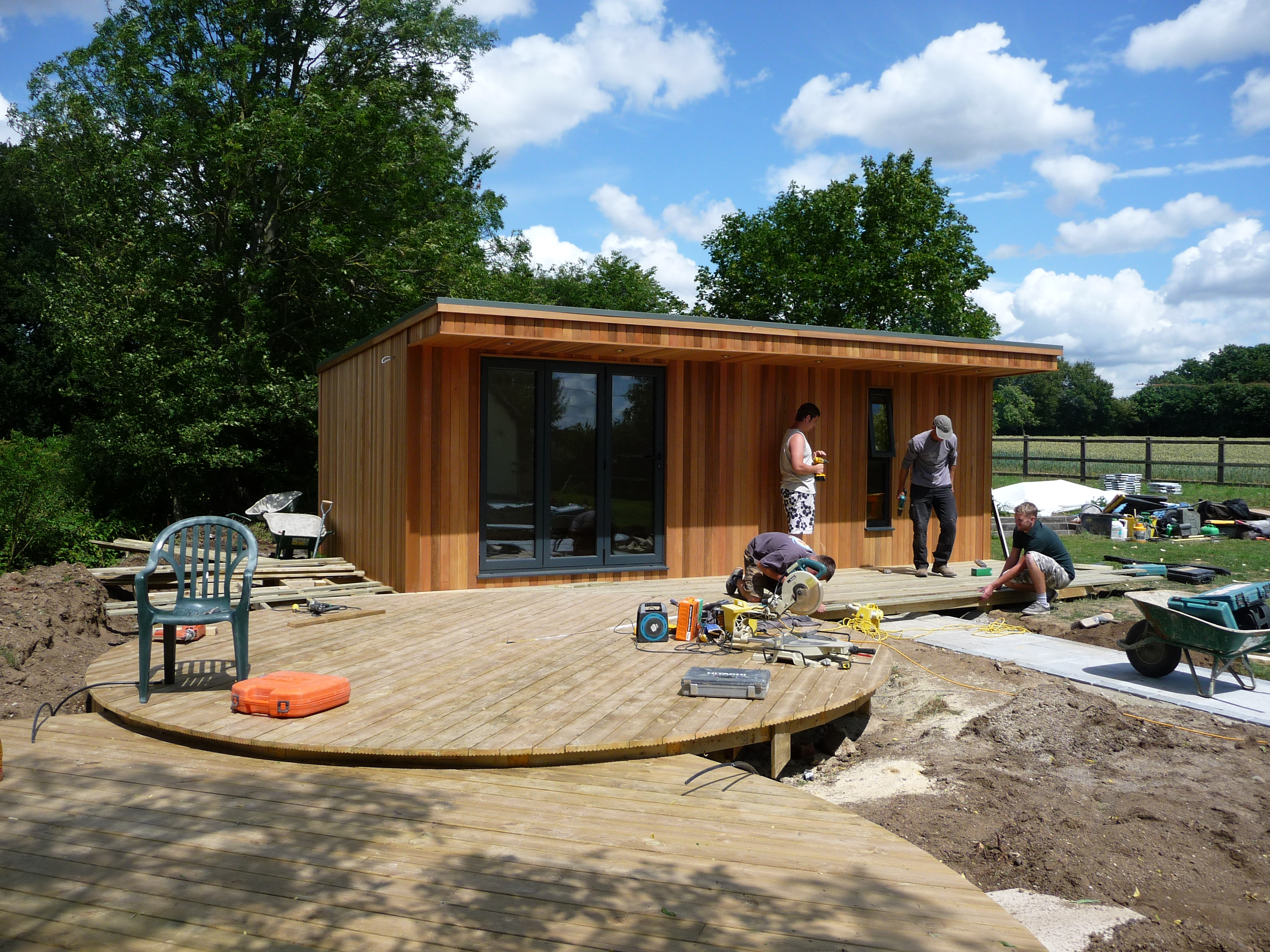
When planning a garden room, one of the first decisions you’ll face is whether to opt for an off-site (modular) build or a traditional on-site construction. Off-site systems promise speed and factory precision, while on-site builds champion flexibility and true customisation. As a specialist in premium, timber-framed garden rooms, we strongly favour on-site construction. It lets clients fine-tune door and window placement, tweak electrical layouts, and make real-time design adjustments that a factory-finished module simply can’t accommodate. This article dives deep into both methods—speed, quality control, cost, sustainability, and customer experience—before explaining why an on-site build ultimately delivers a better-tailored, higher-value garden room.
Defining the Two Approaches
Off-site (modular) builds are pre-manufactured in factory units or pods. Walls, roof, insulation, and even electrics are assembled under controlled conditions, then transported to your garden in one or several large sections. The on-site work is mainly craning modules into place, bolting them together, and making final service connections.
On-site builds bring raw materials—timber frames, SIPs, insulation, cladding, doors, windows—to your property. Skilled teams cut, assemble, and finish everything on location. While certain elements (e.g., windows) are fabricated off-site, the structure itself is erected from the ground up in your garden, allowing live decision-making throughout.
Speed: Off-Site Wins on Paper—But With Caveats
Off-site advocates tout installation in a matter of days. Factory fabrication eliminates weather delays, and cranes can position pods rapidly. Yet real-world timelines often include: transport permits, road restrictions, crane bookings, and site preparation compatible with heavy modules. A storm-delayed crane slot can push the schedule back weeks.
An on-site build—especially within our proven two-week schedule—competes surprisingly well. Groundworks, framing, cladding, plastering, and electrics are all completed in 7-10 working days. Because materials arrive in manageable deliveries, weather windows are easier to plan, and there’s no risk of a massive pod stuck in transit. Speed alone shouldn’t override other factors, especially if flexibility or access issues arise.
Site Access and Logistics: The Hidden Cost of Big Modules
A factory-built pod needs a clear route from road to foundation. Think: wide gates, no overhead cables, stable ground for a 30-tonne crane. In tight urban gardens or mature landscapes, that’s a problem. Removing fences, pruning trees, or hiring specialist lifting gear adds cost and disruption.
On-site construction uses smaller, lighter components carried by hand or via narrow trolleys. No cranes, no wide gateways, no blocked streets. This is a decisive advantage for clients with terraced houses, meandering paths, or protected trees. Our teams routinely build in spaces where a modular unit could never be delivered without major upheaval.
Design Flexibility: On-Site Is Unmatched
Factory pods are fixed templates. Once the walls are fabricated, door openings and window sizes are locked. Want to nudge a window 200 mm to capture a view? Too late. Need an extra double socket by your desk? It’ll be surface-mounted or involve cutting into finished walls.
On-site builds offer live customisation. During framing, you can stand inside the skeleton and decide: “Let’s swap that narrow window for a three-panel slider” or “Move the light switch closer to the door.” Because interior plasterboarding and first-fix electrics happen on-site, positioning sockets, data points, radiators, or projector wiring is effortless. This flexibility transforms a good design into your perfect space.
Quality Control: Factory Precision vs Skilled Craftsmanship
Pro-modular marketing leans heavily on factory precision. CNC machinery and controlled humidity deliver consistent component tolerances. That is true—yet garden rooms are small buildings, not mass-produced timber kit homes. On-site carpentry, when handled by experienced joiners, achieves the same millimetre-perfect joints and insulation continuity.
What matters more is installation quality. A flawless factory wall still needs perfect base alignment, airtight joints, and weather-tight seals once delivered. If a module settles unevenly or a gasket shifts in transport, leaks follow. During on-site assembly, each stage is inspected, adjusted, and signed off, ensuring the final envelope performs as intended.
Weatherproofing and Structural Integrity
Off-site walls may travel 100 miles on a lorry. Vibration and flex can stress joints and compress seals before the building even lands. Once craned in, any micro-gaps are difficult to fix because the structure is already finished.
On-site builds go from pallet to wall in minutes. Membranes, tapes, and insulation remain pristine. We apply breathable membranes and counter-battens in optimal weather windows, then quickly clad the exterior. Every joint is visible and testable until the final boards go on. The result? A watertight shell with no hidden compromises.
Interior Finish and Services: Real-Time Tweaks vs Hardwired Decisions
Modular rooms usually arrive plastered or panelled. If you later decide on extra wall anchors for heavy gym equipment or built-in shelving, you must locate studs blindly or retro-reinforce. Rewiring means chasing finished walls—messy and costly.
With on-site construction, you can walk the space mid-build, mark stud positions, and request additional noggins or conduit drops. Want a surround-sound speaker cable behind the plaster? No problem—our electricians run it during first fix. Decide the floor should be oak instead of laminate? We swap the order instantly. This responsive workflow future-proofs your investment.
Cost Transparency and Upgrades
Factory pods often bundle specification levels: “Bronze, Silver, Gold.” Deviating incurs high upgrade fees because changing a production line is expensive. On-site builds price every element transparently. Choose cedar cladding on two sides and composite on the others, upgrade only the office area to underfloor heating, or add a skylight last minute—costs are straightforward, not punitive.
Because we order materials per project, you pay only for what you use, not a one-size-fits-all package padded for factory overheads.
Sustainability and Waste
Modular factories claim reduced waste, but transporting a 4×6 m pod 200 km by articulated lorry, plus a 30-tonne crane idling for hours, carries a sizable carbon footprint. Off-site timber frames still require road miles for delivery of bulky modules.
On-site builds source materials to exact quantities. Offcuts are reused for noggins or recycled locally. Deliveries are staggered in smaller vans, reducing fuel per drop. We also favour FSC-certified timber and breathable, recyclable insulation. Sustainable choices shouldn’t be limited by factory inventory.
Noise and Neighbour Disruption
A giant crane towering over fences draws neighbours’ attention. The bang of modules lowering into place can be unsettling, and blocking a residential street for hours invites complaints.
On-site work is lower impact: light power tools, small saws, quiet insulation cutting. Our teams respect noise regulations, keeping disturbance minimal and spread evenly over the short build period.
After-Sales Adjustments and Futureproofing
Life changes—so might your garden room’s purpose. Converting an office to a Pilates studio could mean relocating sockets or reinforcing walls for mirrors. Factory-finished walls hide structure and make retrofits tricky.
With on-site builds, we provide stud maps and service routes. Future alterations are straightforward because you know exactly where cables and timbers run. Need an extra window next year? The frame can be modified without dismantling a pod seam.
Insurance, Warranties, and Building Control
Both methods can meet Building Regulation standards, but on-site construction offers easier inspection. Local building control officers appreciate seeing open frames and service runs—off-site pods often arrive sealed, prompting invasive checks if sign-off is required.
Our on-site builds come with structural warranties, roof guarantees, and electrical certificates, backed by photographic evidence of each stage, giving insurers and future buyers confidence.
Cost Comparison: Apples, Oranges, and Hidden Fees
Headline prices for modular rooms may look competitive until you add: specialist transport, crane hire, access prep, and upgrade fees. If your garden requires a tracked carrier or manual haul because the pod can’t reach, labour costs soar.
On-site builds avoid those hidden extras. Ground screws or concrete bases, standard labour, and everyday tools keep budgeting straightforward. You pay for craftsmanship, not logistics.
Case Study: Same Garden, Two Very Different Outcomes
Scenario: A client in a Victorian terrace wants a 5×3 m garden office. An off-site provider quotes a five-day install but needs the neighbour’s tree pruned, two fence panels removed, and a mini-crane hired. Added cost: £2,800. The pod’s door is fixed centre-front; interior sockets are pre-wired. After installation, the client realises glare hits his monitors all afternoon, and the door blocks a pathway.
Our on-site solution: We carry materials through the side passage, no crane required. During framing, the client stands inside and shifts the door to the shady flank wall, adds a corner window, and moves sockets to suit desk layout. Total build time: nine working days. No access damage, no neighbour disputes. The room functions perfectly for remote work. Flexibility wins.
Which Clients Might Prefer Off-Site?
There are niche cases where a modular pod makes sense:
-
Sites with perfect wide access and tolerant neighbours
-
Ultra-tight deadlines where internal spec is secondary
-
Occasional-use rooms where layout precision isn’t critical
Even then, weigh transport costs and future adaptability before deciding.
Conclusion: On-Site Construction Delivers Custom Fit, Real-Time Flexibility, and Long-Term Value
The lure of factory speed is understandable, but when your goal is a garden room that feels like a seamless extension of your home—tailored to views, workflow, furniture, and future needs—on-site construction stands out. It removes access headaches, empowers you to position every door, window, and socket exactly where you want, and ensures any last-minute ideas are welcomed, not penalised. Our experienced teams complete high-quality, timber-framed garden rooms in around two weeks, on your schedule, under Permitted Development, and to the exact spec you envision. Flexible, fast, and built to last—on-site just makes sense.