
Timber Garden Rooms: Cedar vs Thermowood – Which Should You Choose?
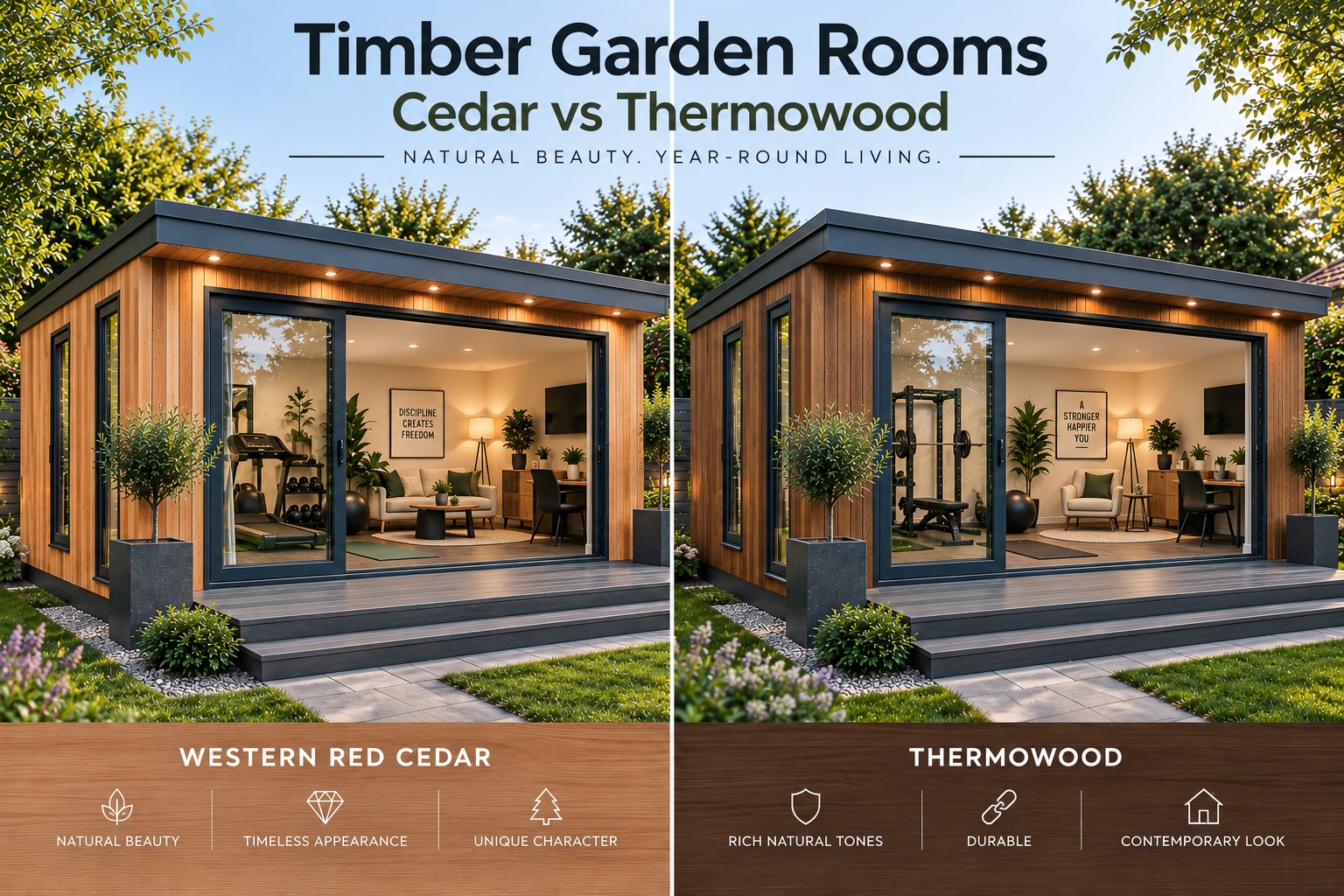
Comparing Appearance, Durability, Maintenance, Weathering and Long-Term Performance
Timber garden rooms have a character that is difficult to replicate with any other external finish.
The warmth, grain and natural variation of real wood can transform a contemporary garden room into an attractive architectural feature while helping it blend naturally into the surrounding garden.
But once you've decided that you want a timber garden room, there is another important choice to make:
Which timber should you choose?
At Oeco Garden Rooms, two of our premium natural timber cladding options are Western Red Cedar and Thermowood.
Both can create a beautiful contemporary garden room, but they have noticeably different appearances and characteristics.
Western Red Cedar is well known for its distinctive colour variation, natural grain and premium appearance. Thermowood offers rich brown tones created through a controlled heat-treatment process, producing a clean, contemporary timber finish with improved stability.
Neither material is automatically the right choice for everyone.
Your decision will depend on the appearance you prefer, how you feel about natural weathering, maintenance expectations and how you want the garden room to complement your home and landscaping.
This guide compares Cedar vs Thermowood garden rooms to help you decide which timber cladding is right for your project.
Why Choose a Timber Garden Room?
Before comparing the two materials, it is worth understanding why timber remains such a popular garden room finish.
There is something inherently attractive about combining modern architecture with natural materials.
A contemporary garden room might have large anthracite glazed doors, clean roof lines and dark trims. Adding timber cladding introduces warmth and texture, preventing the building from feeling overly industrial.
Timber also works naturally within a garden.
Trees, planting, lawns and landscaping already contain different greens, browns and natural textures. Timber cladding can therefore help a substantial garden room sit more comfortably within its surroundings.
Perhaps most importantly, real timber isn't perfectly uniform.
Individual boards can vary in grain and tone.
For many homeowners, that variation is precisely the attraction.
What Is Western Red Cedar?
Western Red Cedar is a timber widely recognised for its attractive natural appearance and suitability for exterior applications.
Its colour can vary considerably between boards, with shades ranging from lighter amber and honey tones through to richer reddish-browns.
The grain also varies naturally.
When several boards are installed together, these differences create a cladding elevation with depth and character.
Rather than looking manufactured, the building clearly displays the individuality of a natural material.
This is one reason Western Red Cedar garden rooms are often associated with premium contemporary design.
What Is Thermowood?
Thermowood is timber that has undergone a controlled thermal modification process.
Heat is used to alter properties within the wood without relying on conventional chemical preservation to create the modification.
The treatment gives the timber a distinctive warm brown colour and improves characteristics such as dimensional stability and biological durability.
The resulting appearance tends to be rich and contemporary.
Depending on the timber and finish, colours can range from warm golden-brown through to deeper chocolate tones.
For a modern garden room, Thermowood can provide the warmth of genuine timber with a relatively consistent overall appearance.
Cedar vs Thermowood: What's the Main Visual Difference?
The biggest difference most customers notice is colour and variation.
Western Red Cedar tends to display greater natural variation from board to board.
You may see lighter golden boards next to deeper reddish or brown sections.
That variation creates a distinctive natural character.
Thermowood generally provides a warmer, richer brown appearance across the elevation.
It still has genuine timber grain and natural variation, but its heat treatment gives the wood a more uniformly warm tone.
Put simply:
Western Red Cedar: distinctive colour variation and natural character.
Thermowood: rich brown tones and a contemporary, coordinated appearance.
Neither is better aesthetically.
It depends entirely on the look you want.
Which Looks More Contemporary?
Both.
It is easy to associate timber with traditional buildings, but timber cladding works extremely well with modern architecture.
Vertical Western Red Cedar cladding paired with anthracite doors and roof trims can look extremely contemporary.
Thermowood can create an equally modern result, particularly when its rich brown colouring is contrasted against dark glazing and decking.
The garden room design matters just as much as the timber itself.
Clean roof lines, large glazed openings, cladding orientation, trims and landscaping all influence the finished appearance.
Which Has More Natural Character?
If your priority is obvious natural variation, Western Red Cedar is likely to appeal strongly.
The differences between individual boards form part of its visual identity.
Some customers love seeing variations in grain and colour because they emphasise that the cladding is genuine timber.
Thermowood also retains natural grain and variation, but its heat treatment gives it a more coordinated colour palette.
This can appeal to homeowners who want natural timber without quite as much contrast between boards.
Thermowood's Rich Brown Appearance
One of Thermowood's defining characteristics is its colour.
The thermal modification process changes the timber throughout rather than simply applying a brown surface coating.
When new, this creates rich brown colouring that works particularly well with contemporary garden-room design.
Dark anthracite frames provide contrast.
Green planting softens the building.
Grey or anthracite decking can provide a neutral base.
The result can be a sophisticated modern exterior without losing the warmth associated with real wood.
Western Red Cedar's Colour Variation
Cedar offers a different aesthetic.
Rather than one dominant brown tone, the elevation can contain a broader mixture of natural shades.
This can make the cladding itself a major architectural feature.
As sunlight moves across the building throughout the day, differences in grain and colour can become more noticeable.
For customers who want their garden room to have a distinctive natural identity, this variation is a major advantage rather than something to eliminate.
Does Cedar Weather Over Time?
Yes.
Like other natural external timbers, Western Red Cedar changes appearance when exposed to sunlight and weather.
If left untreated, its original warmer colouring will gradually weather towards a silver-grey appearance.
This is a natural process and shouldn't automatically be confused with the timber failing.
Some homeowners specifically choose timber because they like this weathered appearance.
Others want to preserve the original cedar colours for as long as practical.
If retaining the original appearance is important, appropriate finishing and ongoing maintenance will need to be considered.
Does Thermowood Turn Grey?
Thermowood also naturally changes colour when exposed to UV light and weather.
If left untreated externally, its original rich brown colouring will gradually weather towards grey.
Again, this is part of the natural weathering process.
If you love the fresh brown appearance of Thermowood, suitable surface treatment and maintenance can be used where appropriate to help retain that appearance.
If you prefer a naturally weathered timber finish, it can instead be allowed to age.
This is an important point when choosing any natural timber garden room:
Decide whether you like how the material will look both when new and as it ages.
Cedar vs Thermowood Maintenance
Both are natural timber products.
If your aim is to retain their original fresh colour indefinitely, you should expect some ongoing maintenance.
The precise maintenance regime will depend on the product, finish, exposure and appearance you want to maintain.
If you're happy for the timber to weather naturally, the cosmetic maintenance requirement can be different.
This is why "Which timber is maintenance-free?" isn't really the right question.
Natural timber changes.
For homeowners who specifically want an exterior with minimal intervention and greater colour consistency, composite cladding may be worth considering instead.
For customers choosing timber, its natural characteristics are usually part of the appeal.
Which Is More Durable?
Both Western Red Cedar and correctly specified Thermowood are used for external cladding applications.
However, durability should never be judged by material name alone.
Quality, profile, installation, detailing and the complete wall construction all matter.
Cladding doesn't work in isolation.
Behind the visible timber should be an appropriately designed building envelope incorporating the structural frame, insulation, membranes and other components required by the construction.
At Oeco, the timber cladding is therefore only the outer visible layer of a much more substantial garden-room structure.
Dimensional Stability and Thermowood
One of the advantages associated with thermal modification is improved dimensional stability.
Timber naturally responds to changes in moisture conditions.
The Thermowood process alters the material so it has reduced moisture-related movement compared with untreated timber of the same species.
This characteristic contributes to its popularity for exterior cladding.
It also demonstrates why Thermowood shouldn't simply be viewed as ordinary timber that has been coloured brown.
The thermal treatment changes properties within the material itself.
Western Red Cedar's Natural Properties
Western Red Cedar has long been valued for exterior applications partly because of its natural characteristics.
It is relatively lightweight and dimensionally stable and contains naturally occurring compounds associated with its durability.
As with any cladding material, however, the quality of the finished installation remains important.
Correct detailing helps the material perform as intended.
Which Timber Works Best With Anthracite Doors?
Both Cedar and Thermowood work exceptionally well with anthracite PVCu doors, windows and trims.
The difference is the type of contrast they create.
Western Red Cedar's varied warm tones stand out strongly against dark frames.
Thermowood's deeper brown colour creates a slightly more coordinated, understated contrast.
Anthracite has become particularly popular in contemporary garden-room design because it provides a neutral architectural frame that works with almost any timber colour.
This allows the natural cladding to remain the visual focus.
Vertical or Horizontal Timber Cladding?
Cladding orientation can significantly alter how a garden room looks.
Vertical timber cladding can emphasise height and create a particularly clean contemporary appearance.
Horizontal cladding can visually emphasise the width of the building and provide a more traditional linear effect.
Neither orientation is inherently superior.
The choice depends on the building design, cladding system and aesthetic you want to achieve.
Whichever is selected, consistency in board spacing and detailing is important to the finished appearance.
Matching Timber Garden Rooms With Decking
Decking provides an opportunity either to coordinate with the cladding or deliberately contrast against it.
Dark anthracite composite decking can look particularly effective with both Western Red Cedar and Thermowood.
The dark floor visually connects with anthracite doors and trims while allowing the timber walls to stand out.
Alternatively, natural-toned decking can create a warmer overall appearance.
You don't need every timber colour to match exactly.
Often, a controlled contrast produces a more interesting design.
Matching Timber Garden Rooms With Fencing
The same principle applies to fencing.
A timber garden room surrounded by natural fencing can create a cohesive landscape, but too many identical timber surfaces can sometimes make the garden feel visually flat.
Planting can help break up these materials.
Green hedges, grasses, trees and shrubs provide contrast and make warm timber tones appear even richer.
When designing the overall garden, think in terms of a palette of materials rather than trying to make every surface identical.
Which Timber Is Better for a Garden Office?
From a practical interior perspective, the external choice between Cedar and Thermowood doesn't determine whether the building makes a good garden office.
The performance of the garden office depends more on its overall construction, insulation, glazing, heating, ventilation, electrics and internal finish.
The choice between Cedar and Thermowood is therefore primarily about exterior appearance and your preferences regarding natural timber.
Both can create a highly attractive professional-looking garden office.
Which Is Better for a Garden Gym?
The same applies to garden gyms.
Whether the exterior is Cedar or Thermowood has little influence on the exercise environment inside.
A garden gym needs appropriate floor space, insulation, ventilation, electrical provision and suitable flooring.
Externally, however, timber can create a premium building that feels less like a conventional gym and more like a natural extension of the garden.
Choose the timber appearance you prefer and concentrate on the internal specification separately.
Does Timber Cladding Affect Insulation?
External timber cladding should not be confused with the insulation itself.
The thermal performance of a garden room depends on the construction of the walls, roof and floor together with doors, windows and other elements.
At Oeco, our garden rooms have fully insulated walls, roof and floor, with the external timber forming part of the overall building envelope rather than acting as the insulation.
This is an important distinction when comparing garden-room suppliers.
Two buildings can both be described as "cedar garden rooms" while having completely different underlying construction specifications.
Always ask what is behind the cladding.
Timber Garden Rooms and Breathable Construction
Moisture management is important within timber-frame construction.
A correctly designed garden room should use suitable layers within the building envelope to help manage external water and internal water vapour.
At Oeco, our construction incorporates waterproof vapour protection and breathable wall elements as part of the overall specification.
This is another example of something customers don't see once the garden room has been completed but which matters to the long-term building.
The beauty of timber cladding should sit over a properly considered structure.
Is Cedar More Expensive Than Thermowood?
Prices can vary according to timber specification, supplier, profile, availability and the quantity required.
It is therefore better to compare the actual garden-room quotation rather than assume one material will always cost a fixed amount more than the other.
Cost also shouldn't be the only consideration.
External cladding covers a substantial proportion of the building and has a major influence on how you feel about the finished garden room.
If you strongly prefer one timber, choosing the cheaper alternative purely to save a relatively small proportion of the total project cost may not give you the result you really wanted.
Think About the View From Your House
Your garden room isn't only something you'll see while using it.
You'll probably look at it from the house every day.
That makes exterior appearance particularly important.
Look through your kitchen, dining-room or living-room windows and consider how the garden room will appear within the wider garden.
Western Red Cedar may become a striking feature.
Thermowood may provide a richer, more understated backdrop.
The right choice depends on the architecture of your home and surrounding landscape.
See Cedar and Thermowood in Person
Computer screens are useful for comparing designs, but timber is a tactile natural material.
Colour can also vary depending on photography, lighting and screen settings.
Where possible, look at real examples before making your final decision.
Seeing an entire elevation is much more informative than looking at a small timber sample.
It allows you to appreciate how individual boards work together and how the material looks beside doors, windows and trims.
At Oeco Garden Rooms, our indoor showrooms allow customers to see full-size garden buildings and compare materials and construction details before ordering.
Cedar vs Thermowood: Which Should You Choose?
Choose Western Red Cedar if you particularly value:
-
Distinctive natural grain
-
Greater colour variation
-
Warm reddish and amber tones
-
Individual character
-
A classic premium timber appearance
Choose Thermowood if you particularly value:
-
Rich brown colouring
-
A contemporary timber appearance
-
Thermal modification
-
Improved dimensional stability
-
A more coordinated overall colour palette
There isn't a wrong answer.
Both materials provide genuine timber character and can create a striking contemporary garden room.
The decision comes down to which appearance you want to see in your garden every day.
The Final Verdict
For many homeowners, choosing between Cedar and Thermowood isn't really a technical competition.
It is a design decision.
Western Red Cedar offers beautiful natural variation and a distinctive premium character.
Thermowood provides rich, warm colouring with the benefits associated with thermal modification and a clean contemporary appearance.
Both will naturally weather if left exposed without a finish intended to retain their original colour.
Both work extremely well alongside anthracite doors, windows and trims.
And both can transform a garden room into an attractive feature rather than simply another building at the end of the garden.
At Oeco Garden Rooms, offering both Western Red Cedar and Thermowood means you don't have to accept one manufacturer's idea of what a timber garden room should look like.
You can choose the timber that best complements your home, your garden and your personal style.
10 Benefits of Choosing a Timber Garden Room
1. Genuine Natural Appearance
Real timber provides grain, texture and subtle variation that gives every garden room individual character.
2. Premium Contemporary Design
Cedar and Thermowood work exceptionally well with modern garden-room architecture, anthracite glazing and clean roof lines.
3. Choice of Two Distinct Timber Styles
Western Red Cedar provides greater natural colour variation, while Thermowood offers rich brown tones and a more coordinated appearance.
4. Complements Garden Landscaping
Natural timber sits comfortably alongside trees, hedges, grasses and other planting, helping integrate the building into the garden.
5. Works With Different Architectural Styles
Timber can complement both contemporary homes and more traditional properties depending on the garden-room design.
6. Can Be Allowed to Weather Naturally
Both Cedar and Thermowood can develop a weathered grey appearance over time if left untreated, providing another aesthetic option.
7. Can Coordinate With Decking and Fencing
Timber cladding can be combined with natural or composite decking, fencing and other landscaping materials.
8. Creates Warmth Against Anthracite Frames
The contrast between warm timber and dark doors, windows and trims creates a particularly attractive contemporary finish.
9. Suitable for Many Garden Room Uses
A timber exterior works equally well for garden offices, gyms, studios, hobby rooms and relaxation spaces.
10. Gives You Greater Design Choice
Choosing between Cedar and Thermowood allows you to personalise one of the largest and most visible surfaces of your garden room.
10 Frequently Asked Questions About Cedar and Thermowood Garden Rooms
1. Which is better, Western Red Cedar or Thermowood?
Neither is universally better.
Western Red Cedar is particularly attractive if you want distinctive grain, colour variation and a classic premium timber appearance.
Thermowood may appeal more if you prefer rich brown tones, a contemporary look and the characteristics created by thermal modification.
The best choice depends primarily on the appearance and characteristics you value most.
2. What is the difference between Cedar and Thermowood?
Western Red Cedar is a naturally durable timber species recognised for its attractive grain and colour variation.
Thermowood refers to timber that has undergone a controlled heat-treatment process that modifies its properties and produces characteristic rich brown colouring.
They therefore achieve their performance characteristics and appearance in different ways.
3. Does Western Red Cedar turn grey?
Yes. When exposed outdoors without a finish designed to retain its original colour, Western Red Cedar will naturally weather and gradually develop a silver-grey appearance.
This is a normal characteristic of exposed timber rather than automatically indicating deterioration.
If you want to help retain the warmer original colouring, suitable maintenance and finishing products need to be considered.
4. Does Thermowood turn grey?
Yes. Thermowood will naturally change colour when exposed to sunlight and weather.
If left untreated, its original rich brown tones will gradually weather towards a grey appearance as the timber is exposed to UV light and the elements.
This natural weathering doesn't automatically mean that the timber is deteriorating.
Some homeowners prefer the weathered appearance and deliberately allow the timber to age naturally. Others want to retain the original warm brown colour for as long as possible.
If maintaining the original colour is important to you, appropriate timber finishes and periodic maintenance should be considered.
5. Which requires more maintenance – Cedar or Thermowood?
Both are natural timber products, so neither should be thought of as completely maintenance-free if your objective is to preserve the appearance it had when first installed.
The amount and frequency of maintenance will depend on the finish, exposure, product specification and appearance you want to maintain.
If you're happy for either timber to weather naturally towards grey, your cosmetic maintenance expectations will be different from someone who wants to retain the original warm colouring.
If very low maintenance and consistent colour are your overriding priorities, a quality composite cladding may be worth considering instead.
6. Is Thermowood real wood?
Yes. Thermowood is real timber, not composite cladding or a timber-effect material.
It undergoes a controlled heat-treatment process that modifies properties within the timber.
This process also creates the distinctive rich brown colouring associated with Thermowood.
Because it remains genuine timber, you still see natural grain and variation within the boards.
This makes Thermowood particularly attractive to homeowners who want a contemporary, relatively coordinated appearance while retaining the character of real wood.
7. Is Western Red Cedar suitable for a modern garden room?
Absolutely.
Western Red Cedar works particularly well with contemporary garden-room architecture.
Its warm natural colouring provides an attractive contrast against anthracite doors, windows, roof trims and decking.
Vertical Cedar cladding can produce an especially modern appearance, while the natural variation between boards prevents the exterior from looking overly uniform.
Combining large areas of glazing, clean architectural lines and Western Red Cedar can create a garden room that feels both modern and naturally integrated into its surroundings.
8. Which timber is best for a low-maintenance garden room?
If extremely low maintenance is your main priority, the more relevant comparison may actually be timber versus composite cladding rather than Cedar versus Thermowood.
Both Western Red Cedar and Thermowood are natural materials and their appearance will change when exposed to weather and sunlight.
Customers who appreciate natural timber often accept this as part of its character.
If you want the exterior to maintain a more consistent manufactured appearance with minimal ongoing treatment, one of Oeco's smooth or woodgrain composite cladding options may be more appropriate.
If you specifically want genuine timber, choose between Cedar and Thermowood based on the appearance and characteristics you prefer.
9. Does timber cladding make a garden room warmer?
Timber cladding forms part of the external building envelope, but it shouldn't be confused with the insulation responsible for the garden room's thermal performance.
A genuinely year-round garden room needs an appropriately designed insulated structure.
At Oeco, our garden rooms have fully insulated walls, roof and floor, with the timber cladding forming the attractive external finish over the underlying construction.
When comparing timber garden rooms from different suppliers, don't simply ask whether the exterior is Cedar or Thermowood.
Ask about the insulation, structural frame, membranes, internal lining, flooring, doors, windows and overall wall construction.
What is behind the timber matters just as much as the timber itself.
10. How do I choose between Cedar and Thermowood for my garden room?
Start with appearance.
If you prefer noticeable natural colour variation, individual character and warm amber-to-reddish tones, Western Red Cedar is likely to appeal.
If you prefer rich brown colouring, a more coordinated contemporary appearance and the characteristics provided by thermal modification, Thermowood may be your preferred choice.
Then consider how you feel about natural weathering.
Both materials will change appearance outdoors unless maintained with appropriate products designed to help retain their original colour.
Finally, try to see both materials on full-size garden rooms rather than making your decision from a small sample or computer image alone.
An entire clad elevation gives you a much better understanding of the overall colour, grain and character.
Ultimately, there isn't a wrong choice.
The best timber is the one you would most enjoy looking at in your garden every day.