
Composite vs Timber Cladding: Which Is Better for Your Garden Room?
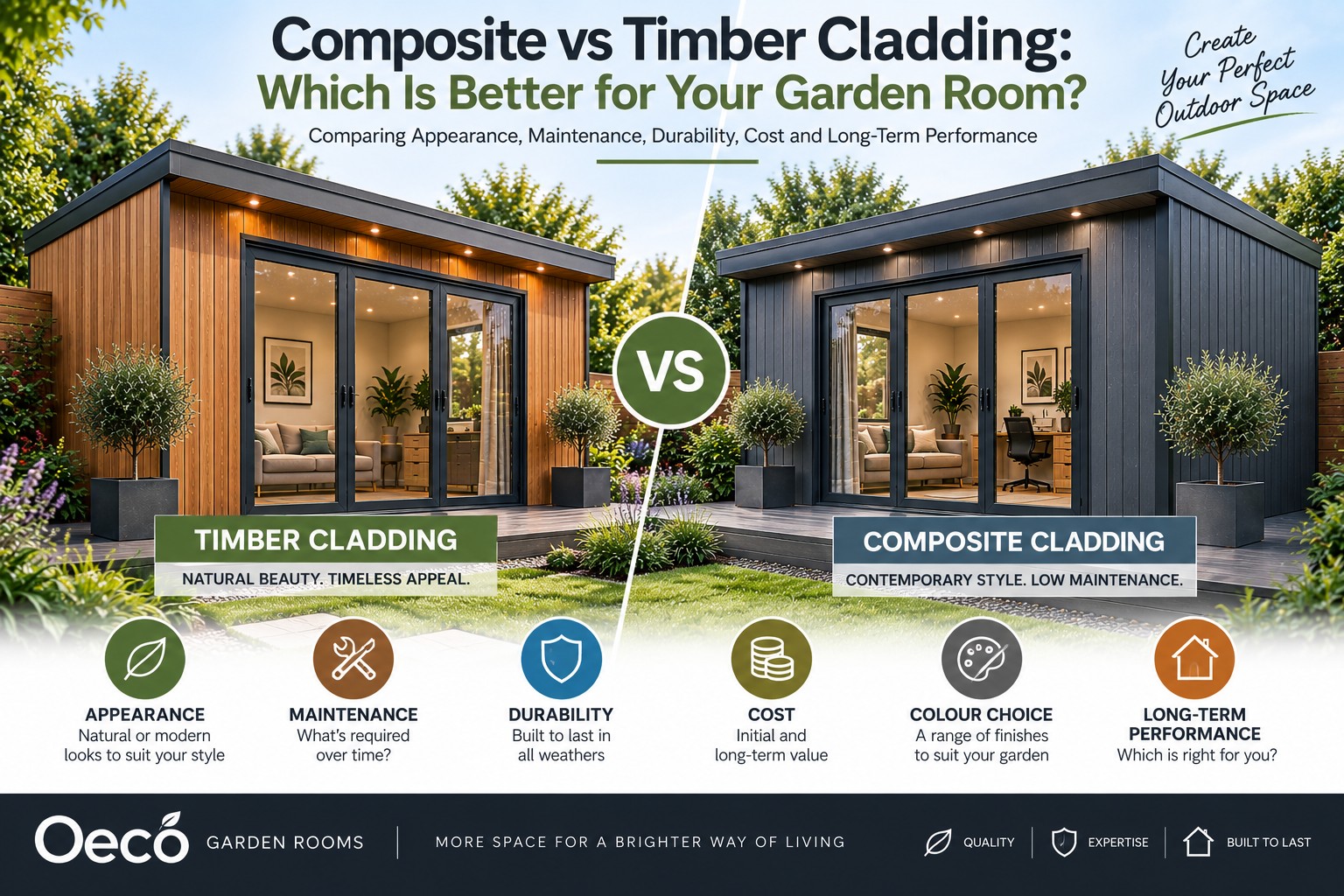
Comparing Appearance, Maintenance, Durability, Cost and Long-Term Performance
Choosing the right external cladding is one of the biggest decisions you'll make when designing a new garden room.
Cladding has an obvious impact on appearance, but its role goes much further than simply determining how your finished garden room looks. Your choice can also affect maintenance requirements, weather resistance, durability and how the building complements your home and garden.
Two of the most popular options are timber cladding and composite cladding.
Timber provides the warmth, character and natural appearance that many homeowners associate with a premium garden building. Composite cladding offers a more consistent finish with minimal maintenance and a wide choice of contemporary colours and styles.
So, when comparing composite vs timber cladding for a garden room, which is better?
There isn't one answer that will suit everyone.
The best garden room cladding depends on the appearance you want, how much maintenance you're prepared to undertake, your budget and whether you prefer the natural ageing characteristics of real timber or the more consistent appearance of composite materials.
At Oeco Garden Rooms, we offer a choice of premium external finishes including Thermowood, Western Red Cedar, Smoothgrain composite and ProClad woodgrain composite cladding, allowing you to select the finish that best suits your garden room and property.
Let's look at the differences.
Why Is Garden Room Cladding Important?
External cladding forms the visible outer finish of your garden room and is an important part of its overall construction.
It helps protect the underlying building structure from the elements while creating the architectural style of the finished room.
This makes choosing cladding quite different from selecting an interior paint colour.
A garden room remains outdoors 365 days a year and needs to cope with rain, wind, sunlight, frost and constantly changing temperatures.
The cladding therefore needs to be appropriate for external use and correctly installed as part of the overall building system.
However, because it covers such a large proportion of the exterior, it is also one of the features that most influences how your garden room looks.
That is where the choice between timber and composite becomes particularly interesting.
What Is Timber Garden Room Cladding?
Timber cladding uses real wood boards to create the external finish of the garden room.
Different species and timber treatments produce very different appearances and performance characteristics.
Two excellent options for contemporary garden rooms are Thermowood and Western Red Cedar.
Both provide the warmth and individuality of genuine timber but have distinctly different appearances.
Natural timber has variations in grain, tone and texture. Rather than every board looking identical, the differences become part of the character of the building.
For many homeowners, this natural appearance is exactly why they choose timber.
Thermowood Garden Room Cladding
Thermowood is timber that has undergone a controlled heat-treatment process designed to modify its properties.
The process gives Thermowood its attractive warm brown colouring and helps improve dimensional stability and durability.
Its colour can range from golden brown through to deeper brown tones, producing a contemporary appearance that works particularly well with anthracite doors, windows and roof trims.
Thermowood is an excellent choice for homeowners who want a genuine timber garden room without the appearance being overly rustic.
The combination of clean architectural lines and warm timber creates a modern but natural finish.
As with other external timbers, its appearance will change over time when exposed to sunlight and weather unless it is maintained with a suitable finish.
For some homeowners this natural ageing is desirable; others prefer to maintain the original warmer colouring.
Western Red Cedar Garden Room Cladding
Western Red Cedar has long been associated with premium garden buildings.
It has a distinctive natural appearance with variations in colour and grain that can create a particularly attractive exterior.
Fresh cedar can display warm reddish, amber and brown tones.
This variation means that a cedar-clad garden room has genuine individuality. No two elevations will look completely identical because timber is a natural material.
Western Red Cedar also complements contemporary architecture extremely well.
Combine cedar with anthracite sliding doors, dark trims and modern landscaping and you get the contrast between natural materials and modern design that has become extremely popular in garden rooms.
Like other natural timbers, cedar will gradually weather when exposed to the elements. Without treatment designed to retain its original colour, it will eventually develop a more silver-grey appearance.
That isn't necessarily deterioration – it is part of the natural weathering process.
What Is Composite Garden Room Cladding?
Composite cladding provides an alternative to natural timber.
Rather than relying on the appearance and characteristics of individual pieces of wood, composite products are manufactured to provide a more controlled and consistent external finish.
Modern composite cladding is available in numerous colours, profiles and surface textures.
This means composite doesn't necessarily have to look like timber.
Some homeowners prefer a smooth contemporary finish, while others want a woodgrain effect that provides some of the visual character associated with timber while retaining the practical advantages of composite.
At Oeco, this is why we offer both Smoothgrain composite and ProClad woodgrain composite options.
Smooth Composite Cladding
Smooth composite cladding is particularly well suited to contemporary garden room designs.
Colours such as Charcoal, Olive Green, Stone Grey and Teak can dramatically alter the character of the same building.
Charcoal can produce a striking architectural appearance, particularly when combined with anthracite doors and trims.
Stone Grey creates a softer neutral appearance.
Olive Green can help the garden room blend naturally into planted surroundings.
Teak provides a warmer finish for homeowners who like timber-inspired colouring but prefer a composite material.
This variety makes composite cladding particularly useful when you're trying to coordinate the garden room with other elements around your property.
Woodgrain Composite Cladding
Woodgrain composite sits somewhere between the appearance of natural timber and the practical benefits associated with composite cladding.
The textured surface provides greater visual character than a completely smooth board.
At Oeco, our ProClad woodgrain composite colour choices include Burnt Oak, Onyx, Pewter, Platinum, Rosewood and Sandstone.
This broad selection means the external finish can become a genuine design choice rather than simply choosing between "wood" and "grey".
Composite vs Timber Cladding: Appearance
Appearance is often the first consideration.
If you want the authentic warmth, grain and variation of real wood, natural timber has an obvious attraction.
Thermowood and Western Red Cedar provide natural variations that manufactured materials intentionally try to replicate.
For some customers, only real timber will achieve the look they want.
Composite, however, offers something different: consistency.
If you prefer uniform colouring, clean lines and a highly contemporary appearance, composite may be more suitable.
There is no universal winner.
It comes down to whether you value natural individuality or manufactured consistency.
Which Garden Room Cladding Requires Less Maintenance?
This is one of the strongest arguments in favour of composite cladding.
Natural timber changes when exposed to sunlight and weather.
If you want to preserve its original appearance, periodic maintenance and suitable treatments may be required.
Some homeowners are perfectly happy to do this because they love the appearance of real timber.
Alternatively, they may deliberately allow timber to weather naturally.
Composite cladding is generally chosen by customers looking for a lower-maintenance exterior.
It doesn't require the same routine treatment simply to preserve a natural timber colour.
It will still benefit from occasional cleaning – every exterior surface gets dirty eventually – but the maintenance commitment is generally lower.
For homeowners who want to install their garden room and spend as little time as possible maintaining its exterior, composite therefore has an obvious appeal.
Composite vs Timber: Which Is More Durable?
Durability shouldn't be judged solely by whether a product is timber or composite.
The quality of the material, correct installation and the overall garden room construction are extremely important.
High-quality timber cladding can provide excellent long-term performance when appropriately specified and installed.
Similarly, good-quality composite cladding is designed specifically for long-term external exposure.
The important point is to compare the specific materials and complete construction, rather than assuming every timber or composite product performs identically.
A garden room is a complete building system.
Cladding works alongside the structural frame, breathable membranes, insulation, roof, trims and other components.
Which Cladding Handles British Weather Better?
Garden rooms in the UK experience almost everything the weather can provide: prolonged rain, wind, frost, summer sunshine and substantial temperature variations.
Both suitable timber and quality composite cladding can be used successfully in these conditions.
The difference is often in how they respond aesthetically.
Natural timber changes with exposure.
Composite is generally designed to maintain a more consistent appearance with less intervention.
This makes composite particularly attractive to customers who want predictable, low-maintenance performance.
Timber appeals to customers who appreciate the fact that natural materials develop character over time.
What About Colour Changes?
This is an important consideration that is sometimes overlooked when customers compare garden room cladding.
Natural timber doesn't remain exactly the same colour indefinitely.
UV exposure and weathering gradually alter its appearance.
Western Red Cedar, for example, can eventually develop an attractive silver-grey appearance if left untreated.
Thermowood will also weather from its original warm brown colouring.
If retaining the original colour is important, appropriate maintenance will normally be required.
Composite cladding generally offers greater colour consistency and provides more predictable long-term appearance, although all exterior materials are exposed to weather and UV conditions.
Composite vs Timber Garden Room Cladding: Cost
Cost is naturally important, but it shouldn't be considered in isolation.
Prices vary considerably according to the specific timber or composite product.
Premium timber such as Western Red Cedar can represent a significant investment.
Likewise, high-quality composite products shouldn't automatically be considered a budget alternative.
The more useful question is:
What am I getting for the price?
Consider appearance, durability, maintenance requirements and how much you value a particular finish.
A cheaper material isn't necessarily better value if it doesn't create the garden room you actually want.
Equally, paying more for a natural timber finish may not make sense if your overriding priority is minimal maintenance.
Which Cladding Is Better for a Modern Garden Room?
Both can look extremely contemporary.
The assumption that timber is traditional and composite is modern isn't really accurate.
Vertical or horizontal timber cladding combined with anthracite trims and large sliding doors can create an exceptionally modern building.
Likewise, smooth charcoal or stone-grey composite can produce a clean architectural appearance.
The final design depends on the combination of materials rather than cladding alone.
Doors, windows, decking, roof trims and landscaping all contribute to the finished appearance.
Matching Garden Room Cladding With Your Home
Your garden room doesn't have to match your house exactly.
In many gardens, a contrasting design can be more effective.
However, it is worth considering the colours and materials already present around your property.
For example, a modern home with anthracite windows might work particularly well with charcoal composite cladding.
A property surrounded by mature planting could look fantastic with Western Red Cedar or Thermowood.
Neutral composite colours can complement contemporary paving, while timber can soften gardens containing large areas of stone or porcelain.
Think about the entire garden rather than the garden room in isolation.
Matching Cladding With Fencing and Decking
Another design opportunity is coordinating your garden room with fencing, decking and other landscaping.
Timber cladding can be paired with natural timber fencing to create a cohesive appearance.
Composite cladding can coordinate particularly well with composite decking and modern fencing systems.
You don't necessarily need everything to be identical.
Sometimes contrast works better.
For example, warm Thermowood cladding can look particularly effective against dark anthracite composite decking.
The objective is to create a balanced palette of materials and colours.
Is Timber Cladding More Environmentally Friendly?
Environmental comparisons aren't always as simple as "natural equals sustainable".
Timber is a renewable material when sourced responsibly, which can be a significant advantage.
Composite materials can vary considerably in composition and manufacturing processes.
The environmental impact of any material also needs to consider factors such as manufacture, transportation, expected service life, maintenance and eventual disposal or recycling.
Rather than relying on broad assumptions, customers interested in environmental performance should consider the credentials of the specific products being offered.
Does Cladding Affect Garden Room Insulation?
Cladding is part of the external building envelope, but it shouldn't be confused with insulation.
A high-performance garden room should have a properly designed insulated structure within its walls, roof and floor.
Changing from timber to composite external cladding doesn't automatically turn a poorly insulated building into a well-insulated one.
When comparing garden rooms, therefore, look beyond the cladding.
Ask what is behind it.
Consider insulation, structural timbers, membranes, internal linings, flooring, glazing and the overall construction specification.
The most attractive cladding in the world cannot compensate for poor underlying construction.
Which Cladding Is Best for a Garden Office?
If your garden room will primarily be used as a garden office, either timber or composite can be an excellent choice.
The cladding itself has little to do with whether the room functions effectively as an office.
Your decision is more likely to depend on appearance and maintenance.
If you want your office to have a warm, premium appearance, cedar or Thermowood may appeal.
If you want a smart exterior requiring minimal ongoing attention, composite may be preferable.
Inside the building, insulation, heating, glazing, lighting and electrics will have a much greater effect on everyday comfort.
What Is the Best Low-Maintenance Garden Room Cladding?
If low maintenance is your number-one priority, composite is likely to be the more attractive choice.
It provides a broad selection of colours and finishes without the same maintenance considerations associated with retaining the original appearance of natural timber.
That doesn't make timber inferior.
It simply reflects the different characteristics of the materials.
Many homeowners happily accept some additional maintenance because natural timber provides exactly the appearance they want.
What Is the Best Cladding for a Premium Garden Room?
Premium doesn't have to mean one particular material.
Western Red Cedar can create an unmistakably high-end natural finish.
Thermowood can provide contemporary warmth and character.
High-quality smooth composite can produce an extremely clean architectural appearance.
Woodgrain composite can provide a completely different premium aesthetic.
A better definition of a premium garden room is one where high-quality materials are combined with good design, substantial construction and professional installation.
Composite or Timber: Which Should You Choose?
The easiest way to decide is to identify your priorities.
Choose timber cladding if you value:
Natural beauty, individual grain patterns, warmth, character and the authentic appearance of real wood.
Thermowood and Western Red Cedar are particularly attractive options for contemporary garden rooms.
Choose composite cladding if you value:
Low maintenance, consistent colouring, contemporary finishes and a broad selection of colour choices.
Smooth and woodgrain finishes also give you considerable flexibility when coordinating your garden room with your home and landscaping.
Neither choice is automatically better.
They simply suit different customers.
See the Difference for Yourself
Cladding is one area where photographs don't always tell the complete story.
Colour, texture, grain and surface finish are much easier to appreciate when you can see the materials in person.
At Oeco Garden Rooms, our two indoor showrooms provide approximately 5,000 sq ft of display space with 12 fully furnished garden buildings on display, giving you the opportunity to compare different garden room styles, finishes and construction details before making your decision.
Being able to see and touch different cladding materials can make choosing between timber and composite considerably easier.
The Final Verdict: Composite vs Timber Garden Room Cladding
So, which is better: composite or timber cladding?
There isn't one material that is right for every garden room.
If your priority is authentic natural beauty and you're happy for the material to weather naturally or undertake maintenance to help retain its original appearance, timber cladding is an excellent choice.
Thermowood provides warm contemporary colouring, while Western Red Cedar offers distinctive grain and natural variation.
If your priorities are lower maintenance, consistent appearance and greater colour choice, composite cladding may suit you better.
Smooth composite provides a clean contemporary aesthetic, while woodgrain composite offers additional texture and character.
Most importantly, don't choose your garden room based solely on its cladding.
Look at the entire specification: structure, insulation, membranes, doors and windows, flooring, electrics, foundations, installation and the quality of the finished building.
Cladding creates the appearance.
What's behind the cladding determines the quality of the garden room.
At Oeco Garden Rooms, our range of timber and composite cladding options allows you to choose the appearance and maintenance level that best suits your home, garden and lifestyle.
10 Benefits of Choosing the Right Garden Room Cladding
1. Creates the Look of Your Garden Room
Cladding is one of the largest visible surfaces on your garden room, so it has a major influence on the finished design. Timber can create warmth and natural character, while composite can provide a cleaner, more uniform contemporary appearance.
2. Gives You a Choice Between Natural and Contemporary Finishes
Thermowood and Western Red Cedar provide authentic timber finishes, while smooth and woodgrain composites offer numerous alternative styles.
3. Allows You to Choose Your Maintenance Level
Customers who don't mind maintaining natural timber can enjoy its distinctive appearance, while those looking for a lower-maintenance exterior can choose composite.
4. Helps Protect the Garden Room Structure
Correctly specified and professionally installed external cladding forms an important part of the garden room's overall weather-protection system.
5. Provides a Wide Choice of Colours
Composite cladding makes it possible to choose from contemporary greys, greens, warmer timber-inspired shades and darker architectural finishes.
6. Can Complement Your Home
Cladding can be selected to coordinate with existing windows, doors, extensions and other architectural features around your property.
7. Can Coordinate With Your Landscaping
Garden room cladding can work alongside fencing, decking, paving and planting to create a more cohesive garden design.
8. Offers Different Long-Term Appearances
Natural timber develops character and changes as it weathers, while composite is generally selected by homeowners wanting a more consistent appearance.
9. Allows Greater Design Personalisation
Choosing between timber, smooth composite and woodgrain composite gives you considerably more freedom to create a garden room that reflects your personal taste.
10. Can Enhance the Premium Appearance of Your Garden Room
High-quality external cladding, combined with good construction, anthracite glazing and carefully chosen trims, can transform a functional garden building into a striking architectural feature.
10 Frequently Asked Questions About Composite vs Timber Garden Room Cladding
1. Which is better for a garden room: composite or timber cladding?
Neither is universally better. Timber is ideal if you want natural beauty, individual grain and authentic character. Composite is particularly attractive if you prioritise lower maintenance, colour choice and a more consistent appearance. The best option depends on your priorities.
2. Which garden room cladding requires the least maintenance?
Composite cladding generally requires less ongoing maintenance than natural timber.
Composite will still benefit from occasional cleaning to remove dirt and organic deposits, but it doesn't require the same type of maintenance that may be needed if you want to preserve the original colour and appearance of natural timber.
Timber such as Thermowood and Western Red Cedar can also be allowed to weather naturally if you prefer that appearance.
3. Does timber garden room cladding turn grey?
Yes. Natural timber exposed to sunlight and weather will gradually change colour.
Western Red Cedar can eventually develop a distinctive silver-grey appearance, while Thermowood will also lose some of its original warm brown colouring as it naturally weathers.
This doesn't necessarily mean that the timber is damaged. It is part of the natural weathering process.
If you want to help preserve the original colour of timber cladding, suitable treatments and periodic maintenance may be required.
4. Is composite cladding more durable than timber?
Both high-quality composite and appropriately specified timber cladding can provide excellent long-term performance.
Composite has the advantage of requiring relatively little maintenance and is manufactured specifically for exterior exposure.
High-quality timber such as Thermowood and Western Red Cedar also has characteristics that make it suitable for external applications.
Durability ultimately depends on the particular product, its quality, correct installation and the construction system behind it rather than simply whether the material is labelled timber or composite.
5. Is composite garden room cladding more expensive than timber?
Not necessarily.
The price depends on the specific materials being compared. Premium timber such as Western Red Cedar can be considerably more expensive than some alternative cladding materials, while premium composite products can also command higher prices.
Rather than comparing materials purely by initial cost, consider the complete picture, including appearance, expected maintenance, durability and long-term value.
6. Which cladding is best for a modern garden room?
Both timber and composite can create an extremely contemporary garden room.
Thermowood or Western Red Cedar combined with anthracite doors, windows and roof trims can create a striking modern appearance while retaining the warmth of natural timber.
Smooth composite cladding in colours such as Charcoal, Olive Green or Stone Grey can produce an even more uniform architectural finish.
The best choice depends on whether you prefer a natural contemporary look or a cleaner, more consistent modern finish.
7. Is Western Red Cedar better than composite cladding?
Western Red Cedar and composite cladding offer different advantages rather than one automatically being better.
Cedar provides genuine timber grain, natural colour variation and a premium appearance that manufactured materials cannot completely replicate.
Composite offers greater colour consistency and lower maintenance.
If authentic natural appearance is your priority, Western Red Cedar may be more appealing. If minimal maintenance is more important, composite may be the better fit for your requirements.
8. What is the difference between Thermowood and composite cladding?
Thermowood is real timber that has undergone a controlled heat-treatment process. It retains natural timber grain and variation and has an attractive warm brown appearance when new.
Composite cladding is manufactured and offers a more consistent appearance with lower maintenance requirements.
Thermowood is particularly suitable for homeowners who want genuine timber character, while composite is attractive to customers wanting a wider choice of colours and less ongoing exterior maintenance.
9. Does garden room cladding affect insulation?
The external cladding is only one component of a garden room's overall wall construction.
The thermal performance of a garden room depends much more heavily on the insulation within the walls, roof and floor, together with the complete construction system, glazing and quality of installation.
When comparing garden rooms, don't assume that attractive or expensive cladding automatically means the building is highly insulated.
Always look at what is behind the cladding.
10. How do I choose between composite and timber garden room cladding?
Start by considering the three things that matter most to you:
Appearance, maintenance and budget.
If you love natural materials, individual grain and the warmth of real wood, consider Thermowood or Western Red Cedar.
If you prefer lower maintenance, consistent colouring and a wider selection of contemporary finishes, consider smooth or woodgrain composite cladding.
It is also worth viewing the materials in person wherever possible. Colours and textures can look very different on a computer screen compared with seeing an entire garden room clad in the material.
At Oeco Garden Rooms, you can compare different garden buildings, materials and finishes at our indoor showrooms before deciding which option is right for your garden.