
EV Charging and Garden Rooms: What You Need to Know
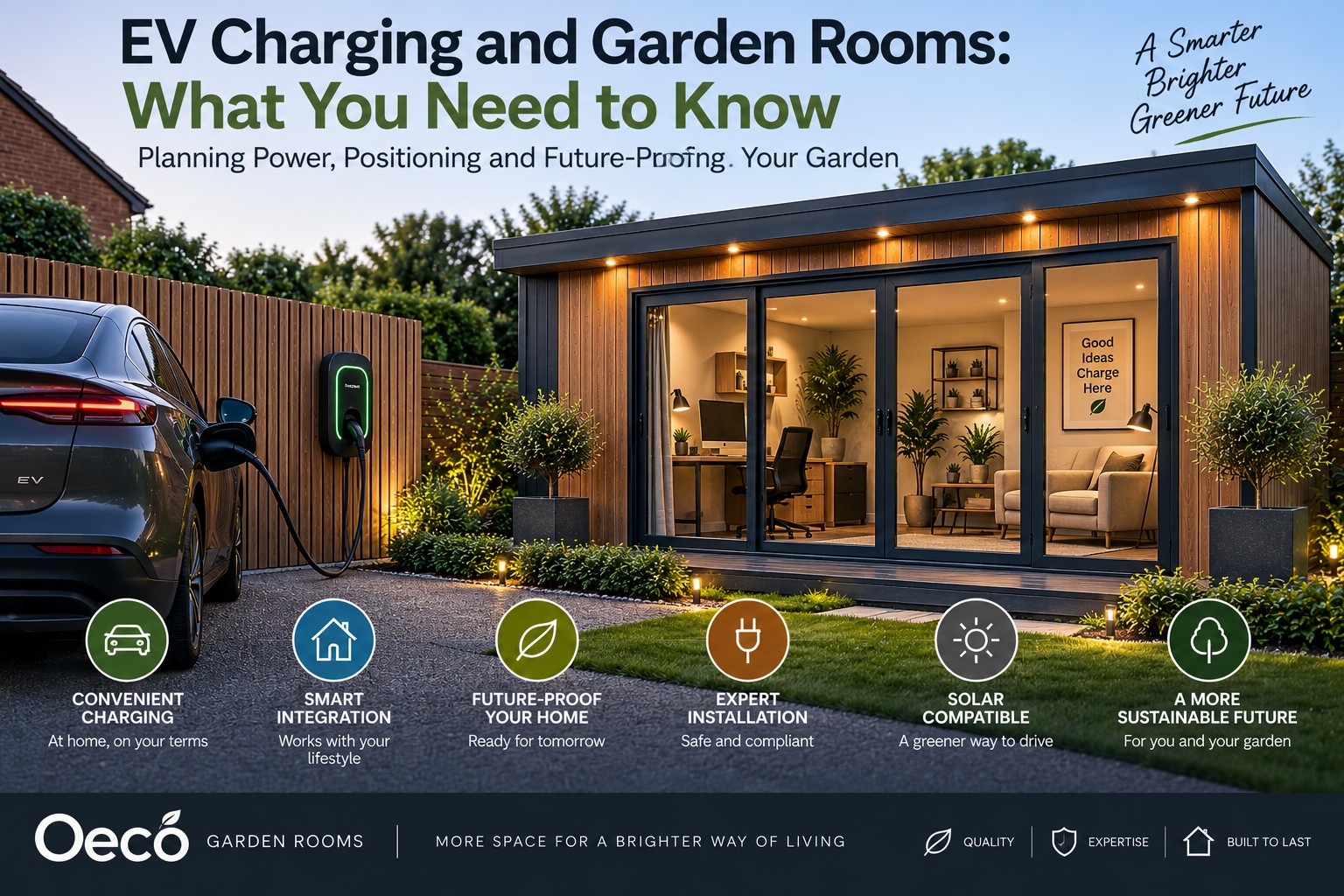
Planning Power, Positioning and Future-Proofing Your Garden
Electric vehicles are becoming an increasingly familiar sight on UK driveways, while garden rooms have become a popular way to create additional space at home.
It therefore makes sense that homeowners planning a new garden room may also start thinking about EV charging.
If your garden room is positioned close to a driveway or parking area, could an EV charger be installed nearby? Should the electrical requirements for both be considered at the same time? And if you don't currently own an electric vehicle, is it worth preparing for an EV charger while your garden room is being installed?
The answer will depend on your property, electrical supply, garden layout and the charging equipment you intend to install.
Importantly, an EV charger shouldn't simply be treated as another electrical socket for your garden room.
Electric vehicle charging places specific demands on an electrical installation and requires appropriate equipment, protection and assessment. Any proposed EV charge point should therefore be designed and installed by suitably competent professionals in accordance with the applicable electrical requirements.
However, even when the garden room and EV charger ultimately have separate electrical arrangements, planning them together can make considerable practical sense.
Cable routes, groundwork, charger positioning and future requirements can all be considered before landscaping and construction are completed.
Here's what homeowners should consider when combining EV charging and a garden room.
Why Consider EV Charging When Planning a Garden Room?
A new garden room often involves more than simply constructing the building itself.
Depending on the project, there may be work involving foundations, electrical cabling, paths, decking and landscaping.
If you're considering installing an EV charger now or in the future, this creates an opportunity to think about both projects together.
Imagine completing a beautiful garden room, new paving and landscaping only to decide a year later that an electrical cable needs to be routed through the same area for an EV charge point.
Planning ahead may allow potential cable routes, ducting and suitable locations to be considered before everything is finished.
This doesn't mean the garden room and charger necessarily need to share the same electrical supply.
It simply means that good planning can avoid unnecessary disruption later.
Can You Install an EV Charger Next to a Garden Room?
Potentially, yes.
If the garden room is positioned close to your driveway or parking space, the area around the building may provide a convenient location for an EV charge point.
However, suitability depends on the individual property.
An installer would need to consider factors including the electrical supply, charger location, cable route, earthing arrangements, protective equipment and the manufacturer's installation requirements.
The physical position of the charger also matters.
Ideally, you want the charging cable to reach the vehicle conveniently without creating an unnecessary trip hazard or having cables stretched across paths and garden areas.
The location should therefore be considered around where the vehicle will actually be parked rather than simply where the charger looks best.
Can an EV Charger Run From Garden Room Electrics?
This is where homeowners need to be careful.
A garden room electrical installation is designed around the expected electrical loads within the building.
These might include lighting, sockets, computers, televisions, heating and other normal equipment.
An EV charger represents a substantial and potentially prolonged electrical load.
You shouldn't therefore assume that because your garden room has electricity, an EV charger can simply be connected to the same circuit.
A suitably qualified installer needs to assess the existing electrical installation and determine the appropriate arrangement.
Depending on the property and installation design, the EV charger may require its own dedicated circuit and protective equipment.
The important point is to treat garden room electrics and EV charging as related planning considerations, but not automatically as the same electrical installation.
Think About EV Charging Before the Garden Room Is Built
Even if you don't currently own an electric vehicle, it may be worth thinking about where a future charger could be positioned.
You don't necessarily need to install one immediately.
Future-proofing could simply mean considering where cables might eventually need to run.
If groundwork is already being undertaken for a garden room, there may be an opportunity to discuss whether suitable provision for future electrical services should be incorporated.
That could potentially reduce the need to disturb completed paving, paths or landscaping later.
The exact solution should always be determined by the relevant professionals, but the principle is straightforward:
It is usually easier to plan infrastructure before a garden is finished than afterwards.
Choosing the Best Position for an EV Charger
The best charger position isn't necessarily on the garden room itself.
Depending on your property, it could be mounted on the house, garage, a suitable post or another appropriate structure.
What matters is that the location works safely and conveniently with the parking arrangement and electrical installation.
Consider where the vehicle's charging port is located.
Different electric cars have charging ports in different positions.
If you regularly park facing forwards, for example, the ideal charger position may be different from someone who reverses onto the driveway.
You should also think about whether a second electric vehicle might be purchased in the future.
A little planning now could make the installation considerably more practical over the long term.
EV Charging Cable Routes
The cable route between the electrical supply and charger is another major consideration.
If a garden room is being installed at the same time, there may already be electrical groundwork taking place.
This is why discussing both projects before work begins can be useful.
A neat, properly planned cable route is preferable to adding visible cables or disturbing finished landscaping later.
The route needs to be designed appropriately for the installation conditions.
Underground cabling, external cabling and cables passing through different areas of the property all have their own installation considerations.
This is another area where professional electrical advice is essential.
Does Your Home Have Enough Electrical Capacity?
Installing an EV charger increases electrical demand.
At the same time, a garden room can introduce additional loads through heating, lighting, computers and other equipment.
This doesn't automatically mean your existing supply is unsuitable.
However, it does mean that overall electrical demand should be considered.
A competent electrical professional can assess the installation and determine what is appropriate.
Modern charging equipment may also offer load-management capabilities that can help manage EV charging in relation to other electrical demand within the property.
The appropriate solution depends on the equipment and installation.
What Is Smart EV Charging?
A smart EV charger can offer additional control over when and how a vehicle charges.
Features vary between products, but compatible systems may allow charging to be scheduled, monitored or adjusted according to electricity tariffs and household demand.
For example, homeowners on suitable time-of-use electricity tariffs may choose to schedule vehicle charging during lower-cost periods.
Smart functionality can also provide information about charging sessions and electricity consumption.
If you're planning a technologically advanced garden room with smart heating, lighting or other connected systems, smart EV charging may fit naturally into the wider approach to managing your home.
However, the charger remains a separate specialist piece of electrical equipment rather than simply another smart-home accessory.
EV Charging and Solar Panels
Another area homeowners may consider is the relationship between EV charging and solar power.
If your home already has solar photovoltaic panels – or you're planning to install them – certain compatible EV charging systems can potentially make use of surplus solar generation.
The actual amount of vehicle charging provided by solar will depend on numerous factors, including the size of the solar installation, weather conditions, household electricity consumption, charger capabilities and vehicle requirements.
It shouldn't be assumed that a few solar panels will provide all the electricity required to charge an EV.
Nevertheless, integrating solar generation, home energy management and EV charging can be an interesting option for homeowners looking at their property as a complete energy system.
Can Solar Panels on a Garden Room Help Charge an EV?
Potentially, solar panels installed on a suitable garden room roof could contribute electricity to the property's wider electrical system, depending on the system design.
However, expectations need to be realistic.
A garden room roof is relatively small compared with many house roofs, and EV batteries can store substantial amounts of energy.
Solar generation from a garden room therefore shouldn't automatically be viewed as a standalone EV charging solution.
Instead, it may form one part of a wider household energy strategy.
The roof orientation, available area, shading, structural considerations and electrical design would all need to be assessed.
Garden Room Office and Electric Vehicle: A Natural Combination
One reason this subject is increasingly relevant is the growth of home working.
A homeowner might spend the working day in a garden office while their electric vehicle is parked and charging nearby.
This can be particularly convenient for people who no longer commute to an office every day.
Instead of relying primarily on public charging, the vehicle can potentially be charged at home while the owner works.
The garden room and charger perform completely different functions, but together they can support a modern way of living and working from home.
Could the EV Charger Be Mounted on the Garden Room?
This needs to be assessed on an individual basis.
Physically attaching an EV charger to a garden room shouldn't be assumed to be suitable simply because the building happens to be conveniently positioned.
The mounting location, structure, electrical supply, cable route, equipment requirements and other technical considerations all need to be assessed.
In some cases, a dedicated charging post positioned nearby may be more appropriate.
In others, another part of the property may provide the best location.
The decision should be based on the overall installation rather than appearance alone.
Don't Forget the Charging Cable
It sounds obvious, but the charging cable itself needs consideration.
A charger positioned neatly on a wall isn't convenient if the cable then has to be stretched across a pedestrian path every time the vehicle is charged.
Think about:
-
Where the car will normally park
-
Where its charging port is positioned
-
The distance from charger to vehicle
-
Pedestrian routes
-
Garden gates
-
Driveway access
-
Whether more than one vehicle may eventually need charging
Good positioning can make everyday charging considerably easier.
Integrating the Charger Into Your Garden Design
An EV charger is a functional item, but that doesn't mean it has to spoil a carefully designed garden.
Modern chargers are available in relatively compact designs and can often be positioned discreetly.
If you're designing the garden room, driveway and landscaping simultaneously, the charger can be considered as part of the overall layout.
For example, landscaping or carefully positioned screening might reduce its visual impact without obstructing access or interfering with installation requirements.
The aim should be to make the charger easy to use without making it the main visual feature of the garden.
Garden Room, Driveway and Landscaping Design
The best results often come from looking at the entire outdoor area rather than treating every component as a separate project.
Your garden may contain:
-
Garden room
-
Decking
-
Paths
-
Driveway
-
EV charger
-
Fencing
-
Planting
-
Exterior lighting
-
Drainage
-
Electrical services
Planning these together can create a much more coherent result.
For example, the route between the driveway and garden room can incorporate lighting, while electrical cable routes can be considered before paving is installed.
This is particularly relevant when undertaking a substantial garden transformation at the same time as installing a garden room.
Future-Proofing for a Second Electric Vehicle
You may currently have one electric vehicle, but what about the future?
If two adults in a household eventually drive electric vehicles, charging requirements may change.
That doesn't necessarily mean installing two chargers today.
It means discussing likely future requirements when the electrical infrastructure is being planned.
The same principle applies if you don't currently own an EV at all.
Future-proofing is about making sensible preparations without necessarily paying for equipment you don't yet need.
EV Charging and Garden Room Security
If your EV charger is located close to a garden room, exterior lighting and security can be considered together.
Appropriate lighting around the parking and charging area can improve visibility after dark.
Depending on your wider home-security arrangements, you may also have cameras, motion-activated lighting or other systems covering the garden and driveway.
Again, the advantage comes from planning the complete outdoor environment rather than adding individual systems one at a time.
Should You Install an EV Charger at the Same Time as a Garden Room?
Not necessarily – but it can be a good time to consider it.
If groundwork and electrical work are already being undertaken, discussing your future EV charging requirements before the garden room and landscaping are completed could make subsequent installation easier.
Even if the charger isn't installed immediately, planning possible routes and locations may prove valuable later.
The key is coordination.
Your garden-room company and electrical professionals need to understand what you are trying to achieve so the different elements can be planned appropriately.
EV Chargers Require Specialist Electrical Consideration
EV charging shouldn't be approached as a DIY extension of a normal garden electrical supply.
Electric vehicle charging equipment has specific electrical and safety requirements.
Installation needs to take account of the individual property, equipment, electrical supply and applicable standards.
A suitably qualified and competent installer should therefore assess and install the charging equipment.
This is especially important if other significant electrical loads – including an insulated garden room – are being added to the property.
Is EV Charging Next to a Garden Room Worth Considering?
If your garden room is positioned near your driveway, EV charging is certainly worth considering during the planning stage, even if you don't intend to install a charger immediately.
The benefit isn't that the garden room magically makes EV charging easier.
The benefit is that you're already making changes to your property.
That provides an opportunity to think ahead.
Electrical routes, groundwork, parking positions, landscaping and future requirements can all be considered before the project is completed.
For some homeowners, the eventual charger may sit beside the garden room.
For others, the house, garage or a dedicated post will be a more appropriate location.
What matters is choosing a solution based on the requirements of your property rather than treating the charger as an afterthought.
At Oeco Garden Rooms, we believe good garden-room design means thinking about how the building will work as part of your wider home and garden.
Planning for future technologies such as electric vehicles, smart-home systems and renewable energy can help create an outdoor space designed not only for today, but for the way you may live in the years ahead.
10 Benefits of Planning EV Charging Alongside Your Garden Room
1. Helps Future-Proof Your Property
Considering EV charging during the garden-room project means potential future requirements can be planned before construction and landscaping are completed.
2. May Reduce Future Disruption
Planning possible cable routes early could avoid having to disturb completed paths, paving or landscaping when a charger is installed later.
3. Creates a More Coordinated Garden Design
The garden room, charger, driveway, paths, lighting and landscaping can be considered together rather than appearing as unrelated additions.
4. Convenient Home Charging
A properly positioned home EV charger can allow an electric vehicle to charge while you're at home, including while you're working in your garden office.
5. Allows Better Charger Positioning
Early planning gives you time to consider parking position, charging-port location, cable reach and pedestrian routes.
6. Allows Electrical Demand to Be Considered Early
Planning a garden room and EV charger provides an opportunity for professionals to consider the additional electrical requirements of both.
7. Can Complement Smart-Home Technology
Compatible smart EV chargers can offer scheduling, monitoring and other controls that may complement other smart technology around the home and garden room.
8. Can Be Considered Alongside Solar Energy
Homeowners interested in solar generation can explore how compatible solar, household energy systems and EV charging could potentially work together.
9. Helps Prepare for Future Vehicles
Even if you don't currently own an electric vehicle, considering potential charging requirements now could make a future installation easier.
10. Makes the Garden Room Part of a Wider Home Improvement Plan
Rather than treating your garden room as an isolated building, planning EV charging encourages you to consider how the driveway, garden, energy use and outdoor living space work together.
10 Frequently Asked Questions About EV Charging and Garden Rooms
1. Can I install an EV charger next to my garden room?
Potentially, yes. If your garden room is positioned near a driveway or parking space, the surrounding area may provide a convenient location for an EV charger.
However, the suitability of the location and electrical arrangement needs to be assessed by an appropriately qualified installer.
2. Can I connect an EV charger to my garden room electrics?
You shouldn't assume that a garden room electrical circuit is suitable for supplying an EV charger.
EV charging can represent a substantial electrical load and has specific installation and protection requirements. The property's electrical installation needs to be assessed and an appropriate charging arrangement designed by a competent professional.
3. Does an EV charger need its own electrical circuit?
EV charge points commonly require a specifically designed electrical supply arrangement and appropriate protective equipment. The exact requirements depend on the charger, property and electrical installation.
A qualified installer should determine what is required rather than attempting to connect a charger to an existing garden-room socket circuit.
4. Can an EV charger be mounted directly onto a garden room?
It may be possible in some circumstances, but it shouldn't be assumed that every garden room is a suitable mounting location.
The structure, electrical installation, charger requirements, cable route and location all need to be considered. A dedicated charging post or another part of the property may sometimes be more appropriate.
5. Should I plan EV charging before my garden room is installed?
If you expect to install an EV charger now or in the future, it is worth considering it during the planning stage.
Potential cable routes, charger locations and future infrastructure can then be discussed before foundations, paths, paving and landscaping are completed.
6. Can solar panels on my garden room charge my electric car?
Solar panels on a suitable garden room could potentially contribute to household electricity generation, which may in turn contribute towards EV charging when combined with compatible equipment and an appropriately designed system.
However, a garden room has limited roof area, so you shouldn't assume it can generate enough electricity to meet all of an EV's charging requirements.
7. What is the best location for an EV charger?
The ideal location depends on where you park, the location of the vehicle's charging port, the electrical supply and the cable route.
The charging lead should conveniently reach the vehicle without unnecessarily crossing pedestrian routes or creating avoidable trip hazards.
8. Can I install the garden room now and add an EV charger later?
Yes. The two installations don't have to happen at the same time.
However, if you think an EV charger is likely to be added later, discussing future provision during the garden-room project may help avoid unnecessary disruption when the charger is eventually installed.
9. Do I need a specialist installer for an EV charger?
EV charging equipment should be installed by a suitably qualified and competent professional familiar with the requirements applying to EV charge-point installations.
The installer can assess your electrical supply, proposed charger, cable route, protection requirements and overall suitability.
10. Is it worth future-proofing for EV charging if I don't own an electric car?
It can be worth considering, particularly if you're already carrying out significant groundwork, landscaping or electrical work as part of a garden-room project.
Future-proofing doesn't necessarily mean buying an EV charger now. It may simply mean thinking about where a future charger could be positioned and discussing potential cable routes or infrastructure requirements before paths, paving and landscaping are completed.
This could make installing an EV charger easier and less disruptive if you switch to an electric vehicle in the future.
The important point is not to install unnecessary equipment, but to plan ahead while you already have the opportunity.