
Garden Room Fire Safety: What You Need to Know
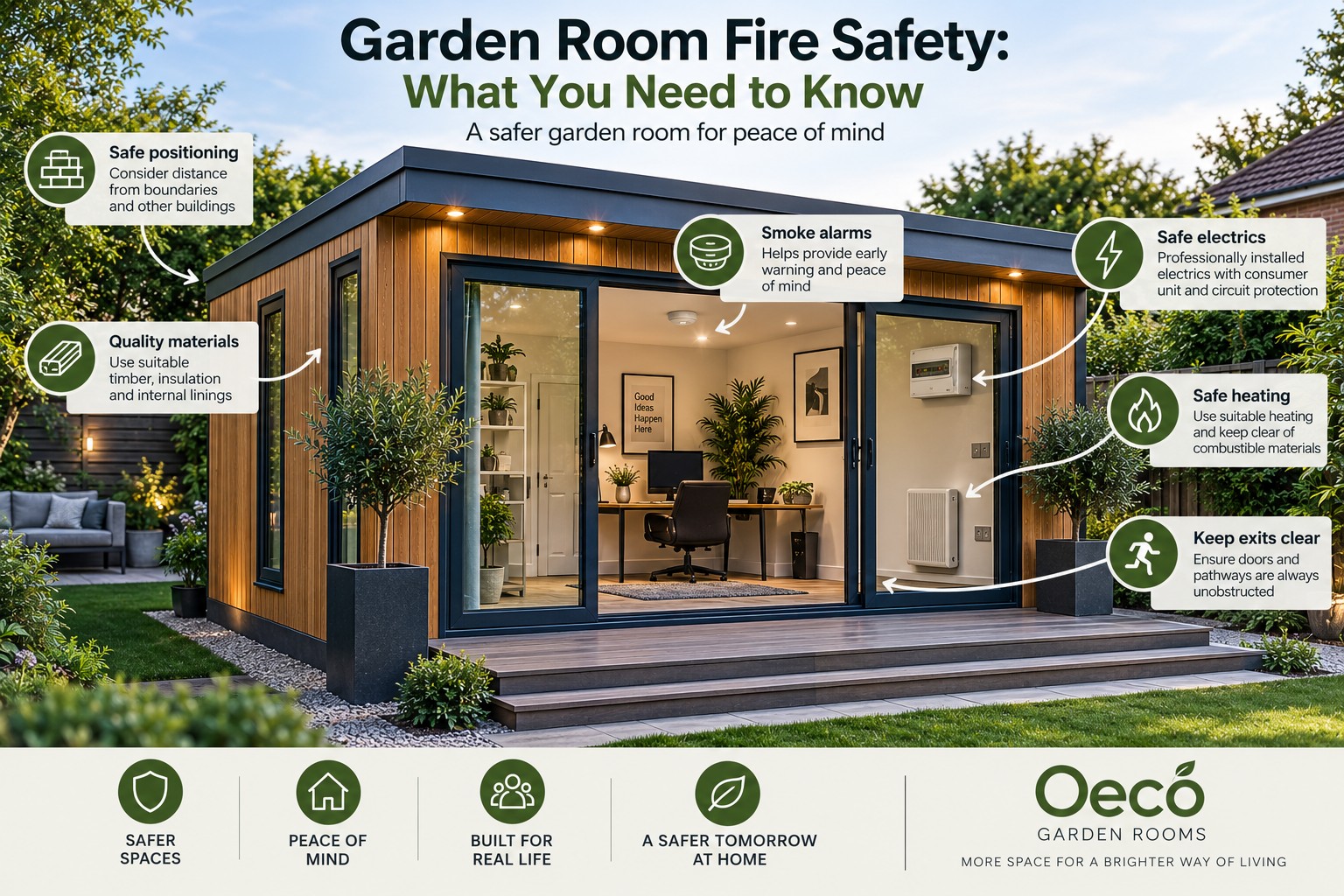
From Building Materials and Electrics to Heating, Positioning and Safe Everyday Use
A modern garden room can provide a comfortable year-round space for working, exercising, relaxing or enjoying hobbies. But just as with any building containing electrical equipment, heating, furniture and other everyday items, fire safety should form part of good garden room design and responsible use.
Fortunately, fire safety doesn't need to make a garden room complicated or intimidating.
Many of the principles are straightforward: appropriate building design, correctly installed electrics, suitable heating, sensible positioning of equipment, unobstructed exits and safe everyday behaviour.
It is also important to distinguish between good fire-safety practice and specific legal requirements.
Not every garden room is identical. Its size, position, intended use and construction can affect which Building Regulations and other requirements apply.
In England, Approved Document B provides statutory guidance relating to fire safety within and around buildings, covering areas including means of warning and escape, internal fire spread, external fire spread and access for the fire service.
That makes it important to consider the individual project rather than relying on a simple assumption that every garden room is subject to exactly the same requirements.
At Oeco Garden Rooms, we believe the details hidden behind the finished surfaces are just as important as appearance. A high-quality garden room should be considered as a complete building – from its structure and insulation to its electrical installation and how it will be used.
Here are the main garden room fire safety considerations homeowners should understand.
Why Garden Room Fire Safety Matters
A garden room may be physically separate from your house, but once it becomes a regularly occupied space it can contain many of the same potential ignition sources and combustible contents as any other room.
A typical garden office might contain:
-
Computers and monitors
-
Chargers
-
Printers
-
Electric heating
-
Lighting
-
Extension leads
-
Furniture
-
Paper and documents
-
Wi-Fi equipment
-
Televisions or audio equipment
A garden gym could contain electrical fitness equipment, heaters and rechargeable devices.
A music studio might contain amplifiers and substantial amounts of electronic equipment.
An entertainment room may contain televisions, games consoles, speakers and additional lighting.
Fire safety therefore isn't simply about what the garden room itself is constructed from.
It is also about how the room is fitted out and used throughout its life.
Start With Good Garden Room Design
Fire safety is easier to consider during the design and construction stages than after the garden room has been completed.
The design process can consider the building's position, materials, doors and windows, electrical installation, heating requirements and intended use.
This is particularly important because garden rooms can serve very different purposes.
A straightforward home office has different requirements and risks from a building containing cooking equipment or specialist machinery.
Before ordering a garden room, be clear about how you intend to use it.
If that use changes substantially in the future, consider whether the building and its services remain appropriate.
Do Building Regulations Apply to Garden Rooms?
This is an area where homeowners should avoid broad assumptions.
Depending on the circumstances, some detached garden buildings may be exempt from certain Building Regulations, but exemption depends on factors including the building's dimensions, construction and location.
Other garden rooms and particular types of work can fall within Building Regulations requirements.
There can also be a difference between planning permission and Building Regulations. Being permitted from a planning perspective does not automatically answer every Building Regulations question.
Where there is uncertainty, the individual project should be checked with the relevant building-control professionals.
For fire safety specifically, the current Approved Document B guidance for England covers fire safety matters within and around buildings.
Garden Room Positioning and Fire Safety
Where a garden room is positioned can matter for several reasons.
Most homeowners naturally think about views, sunlight, garden layout and how far the building is from the house.
Fire safety adds another consideration: the relationship between the garden room and surrounding boundaries and buildings.
External fire spread is one of the areas addressed within Approved Document B. The relevant requirements for an individual project can depend on its construction and circumstances.
This is why positioning shouldn't be considered purely as a landscaping decision.
The location, dimensions and construction of the proposed building should be considered together.
Are Timber Garden Rooms a Fire Risk?
Timber is a combustible material, but that statement alone doesn't tell you whether a particular garden room is appropriately designed or safe.
Timber has been used as a construction material for centuries and is widely used in modern buildings.
A garden room should be assessed as a complete construction system, rather than judging it solely by whether timber appears somewhere within the structure.
Wall linings, insulation, membranes, structural components, cladding, doors, windows and electrical installation all contribute to the finished building.
The relevant fire-performance requirements depend on the building and circumstances.
This is another reason why comparing garden rooms purely on photographs or external appearance can be misleading.
Ask what is actually behind the finished surfaces.
Timber vs Composite Cladding and Fire Safety
Customers often ask whether timber or composite cladding is "safer".
There isn't a useful universal answer based simply on those two labels.
Different timber and composite products can have different properties and classifications.
The complete external wall construction and the requirements applying to the particular building are what matter.
Cladding should therefore be selected as part of the overall specification rather than assuming that every product within one broad material category behaves identically.
The same principle applies to insulation and internal lining materials.
Specific products and complete construction matter more than general labels.
Garden Room Electrics and Fire Safety
Electrical safety is one of the most important considerations in a modern garden room.
A high-quality insulated garden room is likely to contain permanent lighting and electrical sockets, and may also power computers, televisions, heaters and other equipment.
In England, Part P of the Building Regulations addresses electrical safety. Its scope includes electrical installations in gardens or on land associated with a dwelling where the electricity comes from a source located within or shared with that dwelling.
The regulations require reasonable provision in the design and installation of electrical installations to protect people from fire or injury.
This is why garden room electrics should be properly designed, installed, inspected and tested rather than treated like a temporary outdoor extension lead.
At Oeco, our garden rooms include a complete electrical package with a consumer unit, lighting, sockets and concealed wiring, with Part P certification forming part of the electrical installation.
Avoid Overloading Electrical Sockets
Even with a professionally installed electrical system, how the room is used matters.
One common problem in homes and workplaces is trying to run too many high-demand appliances from one socket or extension lead.
Garden rooms are no different.
If you know that your garden office will contain several computers, multiple monitors, printers, heating and other electrical equipment, discuss your requirements when planning the building.
Providing sufficient sockets in sensible locations can reduce the temptation to rely heavily on extension leads and multi-way adapters.
The electrical installation should be designed around the anticipated use of the room rather than simply installing the minimum number of sockets possible.
Be Careful With Extension Leads
Extension leads can be useful, but they shouldn't become a substitute for a properly planned electrical installation.
If your completed garden room immediately requires extension cables running around the perimeter because sockets are in the wrong locations, the electrical layout probably wasn't planned around how the room would actually be used.
Think about furniture before construction.
Where will the desk go?
Where will the television be?
Will there be a printer?
Where will the heater be positioned?
Will you need floor or table lamps?
Planning these details early can create a cleaner, more convenient electrical installation and reduce unnecessary trailing cables.
Heating a Garden Room Safely
A fully insulated garden room can be comfortable throughout the year, but during colder months some form of heating may be required.
Electric heating is commonly used because it can be convenient and controllable.
Whatever system is selected, it should be appropriate for the room and installed and operated according to the manufacturer's instructions.
Portable heaters require particular care.
They shouldn't be covered or positioned where furniture, curtains, paperwork or other combustible items can come into contact with them.
Avoid treating the top of a heater as a convenient place to dry clothing or store objects.
If you are planning regular year-round use, it can be better to consider the heating arrangement during the design stage rather than relying on an unsuitable portable appliance later.
Keep Heat Sources Away From Combustible Materials
This sounds obvious, but garden rooms can become surprisingly full once furnished.
A desk is added.
Then shelving.
Then a sofa.
Then curtains, blinds, paperwork, cushions and decorative items.
The clear space that originally surrounded a heater can gradually disappear.
Periodically look at the room as it is actually being used.
Make sure heaters and other equipment that generates significant heat have appropriate clearance and aren't surrounded by easily combustible materials.
Always follow the equipment manufacturer's installation and safety instructions.
Garden Offices and Fire Safety
A garden office can contain a considerable amount of electrical equipment in a relatively compact space.
A typical workstation might include a laptop or desktop computer, two monitors, printer, router, phone charger, desk lamp and heater.
Individually, these are ordinary household devices.
Collectively, however, they demonstrate why a garden office needs a properly planned electrical installation.
Use reputable equipment, replace damaged cables and chargers, and avoid covering electrical equipment that relies on ventilation.
Don't allow paperwork and other combustible material to accumulate around equipment that produces heat.
At the end of the working day, switch off equipment where appropriate rather than leaving unnecessary devices operating indefinitely.
Rechargeable Batteries and Garden Rooms
Garden rooms increasingly contain equipment powered by lithium-ion batteries.
That might include laptops, phones, tablets, cordless tools, cameras, e-bikes or other rechargeable devices.
Follow the manufacturer's charging instructions and use appropriate chargers.
Damaged batteries, unsuitable replacement chargers or equipment showing signs of overheating or swelling shouldn't simply be ignored.
Charging areas should be kept clear and equipment shouldn't be placed where heat cannot dissipate properly.
If your garden room is also used as a workshop, think carefully about where rechargeable tools and batteries are stored and charged.
Keep the Exit Clear
One of the simplest fire-safety principles is also one of the most important:
Make sure you can get out easily.
Garden rooms often have large glazed doors, which can provide straightforward access.
However, the area around the exit shouldn't gradually become blocked by furniture, storage boxes, gym equipment or other possessions.
This is particularly relevant in garden workshops and storage-heavy hobby rooms.
The route to the door should remain obvious and unobstructed.
Don't design an attractive garden room and then turn the entrance into a storage area six months later.
Think About Fire Safety Before Choosing the Layout
Interior layout is normally discussed in terms of appearance and convenience, but safety should also influence it.
Avoid positioning large pieces of furniture where they interfere with doors.
Think about where heaters will sit.
Consider where high-powered electrical equipment will operate.
Plan enough sockets so cables don't need to cross the room.
If you're creating a workshop, separate work areas from storage where practical.
A well-designed layout can make a garden room both easier and safer to use.
Do Garden Rooms Need Smoke Alarms?
This is a good example of why it is important to distinguish between a sensible safety measure and making a blanket statement about what every garden room legally requires.
The requirements applying to a particular building depend on its design, size, use and regulatory status.
However, smoke detection is certainly something worth considering in a regularly occupied garden room, particularly where the building contains electrical equipment, heating and furnishings.
The appropriate alarm or detection arrangement should be considered according to the individual building and how it is used.
If your garden room has a specialist use or you are uncertain about the requirements, seek advice from the appropriate fire-safety or building-control professional.
Where Should a Smoke Alarm Be Positioned?
If smoke detection is being installed, positioning matters.
Simply buying an alarm and placing it wherever is most convenient isn't necessarily the right approach.
The appropriate type, number and position of alarms depend on the room, its layout and how the building is used.
Always follow the manufacturer's installation guidance and any applicable fire-safety requirements.
Alarms should also be tested and maintained according to the manufacturer's instructions.
A safety device that has been installed and then forgotten about for years cannot simply be assumed to remain operational indefinitely.
What About Heat Alarms?
Smoke alarms and heat alarms perform different functions.
A heat alarm responds to temperature rather than smoke and can be appropriate in certain locations where a conventional smoke alarm could be prone to unwanted activation.
However, this doesn't mean a heat alarm should automatically replace smoke detection in a normal garden room.
The correct detection arrangement depends on the use and layout of the building.
If your garden room incorporates unusual facilities – particularly cooking equipment – obtain appropriate advice about the type of detection required.
Cooking in a Garden Room
Some garden rooms are used primarily as offices or relaxation spaces, while others may incorporate kitchenettes, bars or food-preparation facilities.
Introducing cooking appliances changes the potential fire risk.
A kettle and small refrigerator present very different considerations from an electric hob or oven.
If you intend to incorporate substantial cooking facilities, discuss this at the design stage.
The electrical requirements, ventilation, layout, surfaces, fire detection and other safety considerations may all need additional thought.
Don't assume that a standard garden office specification is automatically suitable for conversion into a full kitchen later.
Garden Room Bars and Entertainment Rooms
Garden rooms are increasingly used as bars and entertainment spaces.
These can contain televisions, refrigerators, drinks coolers, audio equipment, decorative lighting and sometimes portable cooking appliances.
The same basic fire-safety principles apply.
Use electrical equipment appropriate for the environment, avoid overloading sockets and keep heat-producing appliances clear of combustible materials.
Decorative lighting should also be properly installed.
Temporary lighting arrangements shouldn't gradually become a permanent substitute for correctly planned electrics.
Garden Workshops Require Additional Thought
A garden workshop can have a very different risk profile from a home office.
Power tools, battery chargers, timber, paints, finishes, adhesives and other materials may all be present.
If your garden room will function as a workshop, think carefully about what will be stored and used inside it.
Products that are flammable or otherwise hazardous should be stored and handled according to their manufacturer's instructions.
Keep the workspace organised and avoid allowing sawdust, packaging or other combustible waste to accumulate unnecessarily.
Electrical equipment and tools should be maintained appropriately.
The room should also retain a clear route to the exit.
Garden Gyms and Electrical Equipment
A garden gym may contain treadmills, exercise bikes, televisions, sound systems, heaters and other electrical equipment.
Make sure equipment has sufficient space around it and isn't blocking doors.
Avoid running multiple high-powered appliances from unsuitable extension leads.
If you know your garden gym will contain substantial electrical equipment, this should be considered when the electrical installation is planned.
Again, good garden room fire safety starts with designing the room for its intended purpose.
Fire Pits and BBQs Near Garden Rooms
Outdoor living areas are often created around garden rooms.
A patio or deck might contain seating, a barbecue or even a fire pit.
These can create a fantastic entertainment space, but open flames and high temperatures obviously require sensible separation from buildings and combustible materials.
Never position a barbecue or fire pit simply according to where it looks best.
Follow the equipment manufacturer's instructions regarding safe positioning and clearances.
Consider the garden room cladding, decking, fencing, overhanging vegetation and furniture around the appliance.
Portable barbecues should never be used inside a garden room.
Keep Exterior Areas Clear
Fire safety doesn't stop at the garden room doors.
Dry leaves, dead vegetation, cardboard packaging and other combustible material shouldn't be allowed to accumulate around the exterior.
This is another reason regular garden maintenance matters.
If shrubs and planting surround the building, keep them appropriately maintained rather than allowing dead growth to build up directly against the walls.
Access around the building can also be useful for inspection and maintenance.
Garden Room Cladding and External Fire Spread
External appearance is naturally important when choosing garden room cladding, but materials also form part of the building's overall construction.
In England, Approved Document B includes guidance relating to external fire spread.
The requirements that apply depend on the circumstances of the building, including factors such as location and construction.
Rather than assuming that a particular cladding material is universally suitable in every situation, the complete wall construction should be considered.
This is particularly relevant when buildings are positioned close to boundaries.
Insulation and Fire Safety
Insulation is essential for creating a comfortable garden room suitable for year-round use.
But, just like cladding, insulation shouldn't be judged simply by a generic label.
Different insulation materials have different properties.
The complete wall, floor and roof build-up needs to be considered as a system.
When comparing garden rooms, ask what insulation is used and how the building is constructed rather than accepting vague descriptions such as "fully insulated".
A high-performance garden room should combine thermal efficiency with an appropriately considered overall construction.
Internal Wall Linings Matter Too
Once a garden room has been completed, the internal wall finish is what the customer sees.
Behind it may be insulation, membranes, structural framing and other materials.
Internal linings can also form part of the building's fire-performance considerations.
This demonstrates why the visible appearance of two garden rooms can tell you relatively little about their underlying construction.
Two buildings might both have beautiful interiors but use very different materials and construction methods behind the finished surfaces.
Don't Cover Electrical Equipment
Electrical equipment can generate heat during normal operation.
Routers, computers, amplifiers, chargers and other devices often rely on ventilation to dissipate that heat.
Avoid covering them or placing them in enclosed spaces unless the equipment and enclosure are designed for that purpose.
This is particularly relevant in small garden offices where customers may try to hide cables, routers and power supplies inside cupboards.
A tidy appearance is desirable, but not at the expense of adequate ventilation.
Look After Electrical Cables
Electrical leads and cables should be periodically checked for obvious damage.
A cable trapped underneath furniture, repeatedly crushed by a chair or damaged by a pet shouldn't simply continue being used.
The same applies to chargers and power supplies.
Very cheap, unsuitable or damaged electrical accessories aren't worth the risk simply because replacing them is inconvenient.
Where replacement chargers or power supplies are required, use equipment appropriate for the device.
Avoid Daisy-Chaining Extension Leads
Connecting one extension lead into another can result in a confusing and potentially inappropriate electrical arrangement.
If your garden room needs numerous extension leads to function normally, it is worth reconsidering the permanent socket provision.
A properly planned garden room should provide electrical outlets where equipment will actually be used.
This is why discussing your intended furniture layout before installation can be so valuable.
Turn Equipment Off When Appropriate
Not every electrical device needs to remain switched on continuously.
When leaving the garden room for extended periods, turn off equipment where appropriate and in accordance with manufacturer guidance.
This is particularly relevant to portable heating and other equipment that doesn't need to operate while the room is unoccupied.
Smart controls and timers can be useful, but they aren't a substitute for using equipment correctly.
Fire Extinguishers in Garden Rooms
Some homeowners may consider keeping a suitable fire extinguisher in or near their garden room.
Whether this is appropriate depends on the building and its use.
Different types of extinguishers are designed for different types of fire, so simply purchasing any extinguisher without understanding its purpose isn't necessarily helpful.
More importantly, personal safety comes first.
Attempting to fight a developing fire can be extremely dangerous.
If there is a fire, getting people safely out and contacting the emergency services is the priority.
Any firefighting equipment should be suitable for the anticipated risks, maintained correctly and only used where it is safe and appropriate to do so.
Fire Blankets and Cooking Areas
Where appropriate cooking facilities are provided, a suitable fire blanket may form part of the safety arrangements.
Again, this depends on the intended use of the room.
A standard garden office containing a desk and computer is very different from a garden room containing cooking appliances.
This reinforces an important point:
Design the garden room around what it will actually be used for.
Don't Forget Furniture and Soft Furnishings
Fire safety isn't only about the structure and electrical installation.
Once customers move into their garden rooms, they add sofas, chairs, rugs, curtains, cushions and other furnishings.
These can influence the contents and fire load within the room.
Keep soft furnishings appropriately separated from heaters and other heat-producing appliances.
If candles or other naked flames are used, they require particular care and should never be left unattended.
Battery or LED alternatives can provide a similar atmosphere without an open flame.
Keep Garden Room Doors Easy to Open
A garden room exit needs to remain practical.
Don't place furniture where it restricts the opening of doors.
Locks and handles should be kept in good working condition.
If the room is occupied, people inside should understand how to operate the exit.
This becomes particularly relevant if the garden room is used by customers, employees, guests or other people unfamiliar with the building.
Fire Safety for Garden Rooms Used for Business
Some garden rooms are used for commercial purposes rather than purely domestic activities.
Examples might include treatment rooms, beauty rooms, consulting spaces or other businesses receiving clients.
The legal and fire-safety responsibilities associated with a business premises can differ from those applying to a private domestic garden room.
If customers, employees or members of the public will use the building, obtain appropriate professional advice about the requirements applying to that use.
Don't assume that guidance for a private home office automatically covers a commercial premises.
Regular Maintenance Matters
Fire safety isn't something considered once on installation day and then forgotten.
How a garden room is used changes over time.
Additional equipment is purchased.
Furniture is moved.
Extension leads appear.
Heaters are replaced.
Plants grow around the exterior.
Regularly look around the garden room and ask whether anything has changed that could create unnecessary risk.
Simple maintenance and good housekeeping can prevent small problems from becoming bigger ones.
A Safe Garden Room Starts With Good Planning
The best approach to garden room fire safety is not to focus on one individual product.
Instead, consider the complete building and how it will be used.
Think about:
-
Position and boundaries
-
Construction materials
-
Insulation and linings
-
Electrical installation
-
Heating
-
Fire detection
-
Furniture layout
-
Exit routes
-
Outdoor cooking and heating
-
Everyday electrical equipment
-
Future changes in use
At Oeco Garden Rooms, we believe a quality garden room should be designed for long-term, comfortable use rather than simply looking attractive on the day it is installed.
The parts you can see matter.
But the construction, electrical installation and safety considerations behind them matter just as much.
10 Benefits of Good Garden Room Fire Safety Planning
1. Helps Protect People Using the Garden Room
The most important benefit is straightforward: good design and responsible use can help reduce avoidable risks to people occupying the building.
2. Encourages Safer Electrical Installation
Planning the garden room properly allows the electrical system to be designed around its intended use rather than relying on temporary extensions and adapters later.
3. Helps Prevent Socket Overloading
Providing enough correctly positioned sockets can reduce reliance on multi-way adapters and extension leads.
4. Makes Heating Safer
Considering heating during the design stage allows suitable equipment and positioning to be planned before furniture fills the room.
5. Keeps Exit Routes Accessible
A carefully considered furniture layout helps maintain straightforward access to the garden room doors.
6. Encourages Appropriate Material Selection
Looking beyond appearance encourages consideration of the complete wall, roof and floor construction rather than cladding alone.
7. Helps Identify Risks Before Construction
Building position, boundaries, electrical requirements and intended use can all be considered before the garden room is installed.
8. Supports Safe Year-Round Use
A garden room used throughout winter is likely to rely more heavily on heating, lighting and electrical equipment, making good planning particularly valuable.
9. Helps Future-Proof the Garden Room
Thinking about potential future uses can help avoid inappropriate alterations or electrical additions later.
10. Provides Greater Peace of Mind
Knowing that construction, electrics, heating and everyday use have all been properly considered can help you enjoy your garden room with greater confidence.
PART 3 – Frequently Asked Questions
10 Frequently Asked Questions About Garden Room Fire Safety
1. Are timber garden rooms a fire risk?
Timber is combustible, but describing every timber garden room simply as a "fire risk" is too simplistic.
Timber is widely used as a construction material. What matters is the complete design and construction of the building, including its structure, wall build-up, insulation, linings, cladding, electrical installation and location.
The requirements applying to a particular garden room will depend on its individual circumstances.
2. Do garden rooms need smoke alarms?
There isn't a useful blanket answer that applies to every garden room in every circumstance.
Requirements can depend on the building, its use and whether particular Building Regulations apply.
However, smoke detection is certainly worth considering in a regularly occupied garden room containing electrical equipment, heating and furnishings.
Where there is uncertainty, seek appropriate advice for the individual building and follow current official guidance and alarm-manufacturer instructions.
3. Do Building Regulations apply to garden rooms?
Some detached garden buildings can be exempt from certain Building Regulations where specified conditions are satisfied, while other buildings and types of work can fall within Building Regulations requirements.
Factors can include the building's size, location, construction and intended use.
Planning permission and Building Regulations are also separate matters.
If you're uncertain about a particular project, check with the relevant local authority building-control service or an appropriately registered building-control professional.
4. How close can a garden room be to a boundary?
There isn't one fire-safety distance that can simply be applied to every garden room without considering its size and construction.
The position of an outbuilding in relation to boundaries can affect both Building Regulations considerations and, separately, planning rules.
The construction of the building can also become relevant when it is positioned close to a boundary.
The proposed garden room should therefore be assessed according to its individual dimensions, position and construction rather than relying on a general rule found online.
5. Are garden room electrics covered by Building Regulations?
In England, Part P addresses electrical safety in dwellings and associated areas. Its scope includes electrical installations in gardens or on land associated with a dwelling where the electricity comes from a source located within or shared with the dwelling.
Garden room electrical work should therefore be properly designed and installed, with applicable Building Regulations requirements followed.
At Oeco, our garden rooms include a complete electrical package, including a consumer unit, LED lighting, sockets and concealed wiring, with Part P certification forming part of the installation.
6. Can I use an electric heater in a garden room?
Electric heating is commonly used in insulated garden rooms, but the heater needs to be suitable for the space and used according to the manufacturer's instructions.
Keep heaters appropriately clear of furniture, curtains, paperwork, clothing and other combustible materials.
Portable heaters shouldn't be covered or used as improvised clothes dryers.
If the garden room will be heated regularly, consider the heating requirements during the design stage.
7. Is it safe to use extension leads in a garden room?
Extension leads can be useful for appropriate temporary applications, but they shouldn't compensate for inadequate permanent socket provision.
Avoid overloading them or connecting extension leads together.
If you find that your garden room permanently depends on several extensions and adapters, consider whether additional professionally installed sockets would provide a better solution.
8. Can I have a kitchen or cooking appliances in a garden room?
The answer depends on what you mean by cooking facilities and the design and intended use of the garden room.
A kettle and refrigerator are very different from installing a hob, oven or full kitchen.
Substantial cooking facilities can introduce additional electrical, ventilation and fire-safety considerations and may affect regulatory requirements.
If you want a garden room containing a kitchen, discuss this at the design stage and obtain the appropriate professional advice rather than adding significant cooking equipment later without assessing the implications.
9. Can I have a fire pit or BBQ next to my garden room?
Barbecues and fire pits should be positioned and used according to the manufacturer's safety instructions and kept appropriately away from buildings, combustible materials, fencing, furniture and vegetation.
Never use a portable barbecue inside a garden room.
Also consider decking and external cladding when deciding where outdoor cooking or heating equipment will be positioned.
A convenient entertainment layout should never take priority over safe clearances.
10. What is the most important garden room fire-safety advice?
Think about fire safety as part of the complete garden room, rather than relying on one individual feature.
Good construction, appropriate positioning, professionally installed electrics, suitable heating, sensible appliance use, appropriate detection where required, clear exits and regular maintenance all contribute.
Most importantly, make sure the garden room is designed for its intended use.
If you substantially change how the building is used – particularly by adding cooking equipment, commercial activities or significant electrical loads – reassess whether the existing specification remains appropriate.