
Garden Room Lighting Ideas: How to Plan the Perfect Lighting
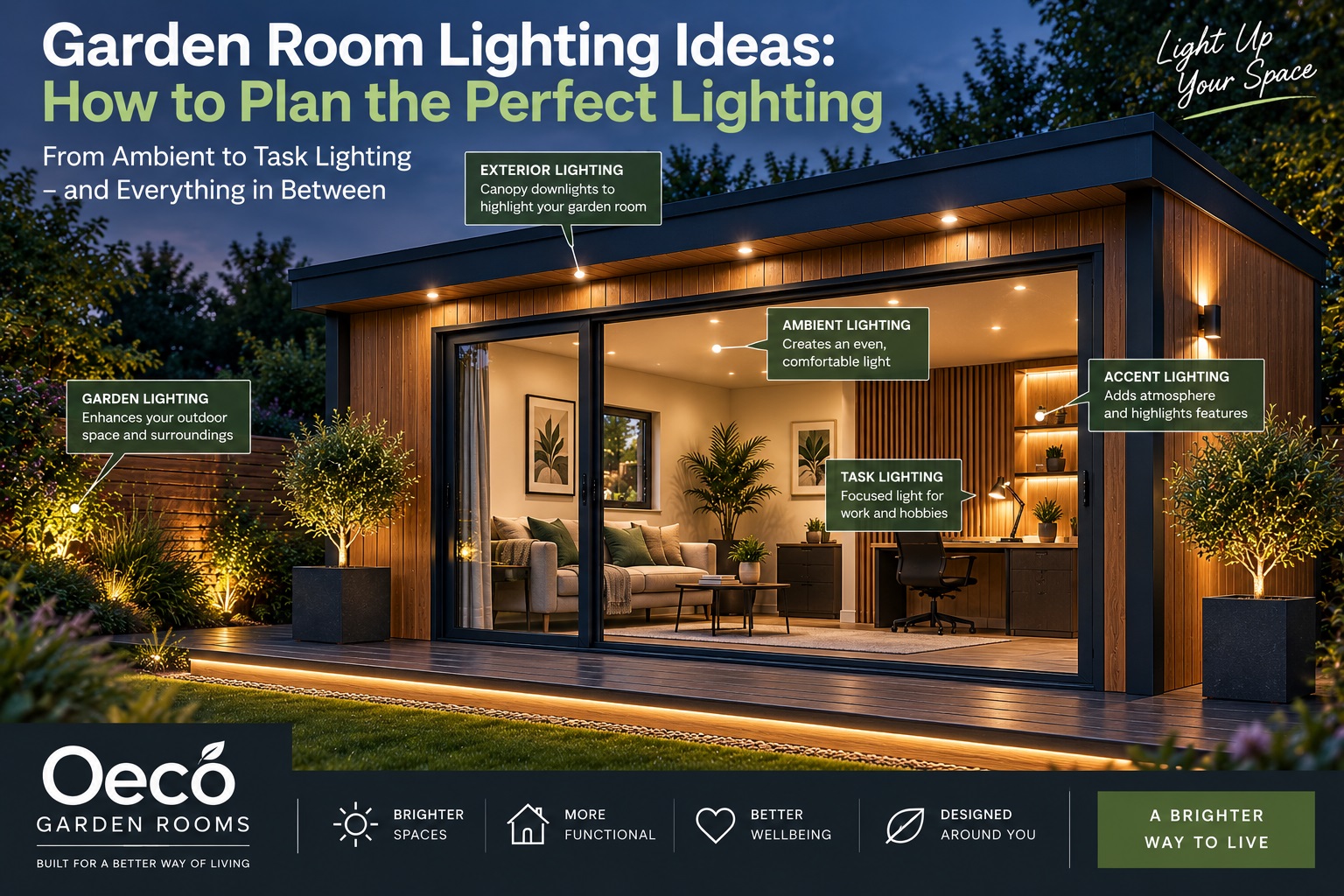
From Ambient and Task Lighting to Accent Lighting and Exterior Lights
Good lighting can completely transform a garden room.
Whether you're creating a garden office, home gym, art studio, games room, music room or relaxing space, the right lighting helps make the room comfortable, practical and enjoyable throughout the year.
Yet garden room lighting is sometimes treated as an afterthought.
Customers understandably spend time choosing the size of their garden room, external cladding, doors, windows and flooring, but the position and type of lighting can have just as much influence on how the finished room feels.
A single bright ceiling light may technically illuminate a room, but it rarely creates the most comfortable or flexible environment.
The best garden room lighting design usually combines natural daylight with several different types of artificial lighting.
This is often called layered lighting.
By combining ambient, task and accent lighting – together with carefully planned exterior lights – you can create a garden room that adapts to different activities, seasons and times of day.
Here are the most important garden room lighting ideas to consider when planning your new space.
Why Is Garden Room Lighting Important?
A modern insulated garden room is designed to be used throughout the year.
That means lighting needs to work just as effectively on a dark December afternoon as it does on a bright summer evening.
Good lighting serves several purposes.
It allows you to work comfortably, helps create atmosphere, highlights interior features and makes the room feel welcoming after dark.
Lighting can also influence how large a room feels.
A poorly illuminated garden room with dark corners can feel smaller than it really is. A well-planned combination of ceiling, wall and accent lighting can create a much greater feeling of depth and space.
The objective isn't necessarily to install more lights.
It is to put the right type of light in the right place.
Start With Natural Light
Before thinking about electrical lighting, consider the greatest source of free illumination available: daylight.
Large glazed doors and windows can flood a garden room with natural light during the daytime.
At Oeco Garden Rooms, large glazed door sections and opening windows help create bright interiors while maintaining a strong visual connection between the garden room and surrounding outdoor space.
The position of your garden room and glazing can influence how daylight behaves throughout the day.
A room receiving strong afternoon sunlight will have very different lighting characteristics from one positioned in a shaded part of the garden.
Natural light should therefore form part of the overall lighting plan rather than being considered separately.
However, daylight alone isn't enough.
During winter, daylight hours are short, and a garden room used for work or leisure may regularly be occupied before sunrise or after sunset.
Artificial lighting needs to take over comfortably when natural light disappears.
What Is Layered Lighting?
Layered lighting means using several types of lighting rather than expecting one fitting to do everything.
A well-designed garden room might combine:
Ambient lighting – providing the main general illumination.
Task lighting – providing focused light for specific activities.
Accent lighting – adding atmosphere and highlighting architectural or decorative features.
Exterior lighting – illuminating entrances, canopies, decking and surrounding areas.
These different layers can be controlled independently, allowing the atmosphere of the room to change depending on how you're using it.
This is particularly useful in a multi-purpose garden room.
The bright lighting required for working at a desk at 10am may be completely different from the softer lighting you want while relaxing with a drink at 9pm.
Ambient Lighting for a Garden Room
Ambient lighting provides the general background illumination within the room.
In many garden rooms, ceiling lighting performs this role.
LED ceiling panels or carefully positioned LED downlights can distribute light effectively throughout the interior without taking up valuable space.
The objective is usually to create relatively even illumination rather than one extremely bright area surrounded by shadows.
Think about the size and shape of the room when planning the number and position of fittings.
A long garden room may need lighting distributed along its length, while a compact room may require fewer fittings.
Furniture layout also matters.
Planning the lighting before construction allows the electrical installation to complement how the finished room will actually be used.
Task Lighting for Garden Offices
If your garden room will be used as a home office, task lighting becomes particularly important.
A desk lamp or dedicated light positioned around the working area can provide focused illumination for reading, writing and other detailed work.
This means you don't necessarily need the entire garden room brightly illuminated whenever you're working.
Task lighting can be combined with softer ambient lighting to create a more comfortable environment.
Computer screens also need consideration.
A badly positioned bright light can create reflections and glare on monitors.
The desk, windows and artificial lighting should ideally be planned together so that you have plenty of usable light without making screen-based work uncomfortable.
Garden Room Lighting for a Home Gym
A garden gym has very different lighting requirements from a relaxing garden lounge.
Generally, you want good overall visibility and an energising environment.
Bright, evenly distributed LED lighting can work particularly well.
Mirrors, if fitted, will also reflect light around the room, so the position of fittings should be considered carefully to minimise unwanted glare.
If the gym is also used for yoga, stretching or relaxation, dimmable lighting can provide greater flexibility.
Bright lighting can be used during workouts and reduced afterwards to create a calmer atmosphere.
This illustrates why thinking about how a garden room will be used is more important than simply choosing fittings because they look attractive.
Accent Lighting for Garden Rooms
Accent lighting is where garden room lighting becomes more creative.
Rather than illuminating the entire room, accent lighting highlights particular features.
You might use it to illuminate:
- Shelving
- Artwork
- Feature walls
- Timber slat panels
- Display cabinets
- Plants
- Architectural details
LED strip lighting can be particularly effective when integrated into shelving or furniture.
The light source can often be concealed so that you see the illumination rather than the fitting itself.
Accent lighting isn't essential for basic functionality, but it can dramatically change the atmosphere of a garden room.
Warm White or Cool White Lighting?
One of the most important choices is the colour temperature of your lighting.
Colour temperature is measured in Kelvin (K).
Lower colour temperatures produce warmer, more yellow-toned light, while higher colour temperatures create a cooler, whiter appearance.
For a relaxing garden room or entertainment space, warmer lighting can create a softer and more comfortable atmosphere.
A garden office, workshop or hobby room may benefit from a more neutral light that provides good visibility.
There isn't one correct colour temperature for every garden room.
Again, the intended use of the space should guide the decision.
You can also combine different lighting layers so that brighter task lighting is available when needed while warmer ambient lighting creates a relaxed atmosphere at other times.
Should Garden Room Lights Be Dimmable?
Dimmable lighting is worth considering if you want the garden room to perform several functions.
A dimmer allows the same lighting installation to create very different environments.
At full brightness, the room can be suitable for working, hobbies or cleaning.
Reduce the light level and it can become a much softer space for watching television, listening to music or entertaining friends.
This flexibility can be particularly valuable in larger garden rooms that serve as both a workspace and leisure room.
When planning dimmable LED lighting, compatible fittings, drivers and controls need to be specified.
Garden Room Lighting for Reading
If your garden room will include a reading chair or relaxation area, consider dedicated lighting nearby.
A floor lamp, wall-mounted reading light or table lamp can provide focused illumination without requiring the main ceiling lighting to be at full brightness.
This creates a much more comfortable evening environment.
It also demonstrates the value of planning electrical sockets.
Portable lamps need somewhere convenient to plug in.
If the furniture arrangement is known before the electrical installation is completed, sockets can be positioned where they're actually needed rather than relying on extension leads later.
Lighting a Garden Room Art or Hobby Studio
Creative work often requires good-quality, consistent illumination.
If your garden room will be used for painting, drawing, crafts, model making or other detailed hobbies, colour rendering and light distribution become particularly important.
Natural daylight can be extremely useful, but it changes considerably throughout the day.
Good artificial lighting provides greater consistency.
Task lighting can then be added directly above or beside work surfaces where greater illumination is required.
The key is to avoid strong shadows across the area where you're working.
Garden Room Lighting for Entertainment
A garden room used as a bar, games room, cinema room or entertainment space gives you far more freedom to experiment with lighting.
You may want relatively low ambient illumination combined with accent lighting around shelving, a bar area or television wall.
LED strips can add subtle background illumination.
Wall lights can provide a softer alternative to ceiling lighting.
Dimmers allow the room to move from bright and practical to atmospheric in seconds.
Rather than one lighting circuit controlling everything, multiple circuits can provide greater flexibility.
Don't Forget Lighting Controls
Where switches are positioned is just as important as where lights are positioned.
You should be able to enter and leave the garden room without walking across a dark space to find a switch.
If several lighting layers are installed, separate controls allow you to choose exactly which lights are operating.
Smart lighting is another option.
Depending on the system, lights can potentially be controlled using wall switches, remotes, smartphones, voice assistants or automated schedules.
Not everybody needs smart lighting, but it can provide useful flexibility.
The important point is to choose controls that make the garden room easier to use rather than adding technology purely for its own sake.
Exterior Garden Room Lighting
Lighting shouldn't stop at the doors.
Exterior garden room lighting can make the building look completely different after sunset.
Canopy downlights are particularly effective on contemporary garden rooms.
They illuminate the area immediately outside the doors while highlighting the building's external cladding and architectural lines.
Exterior wall lights can also be positioned around entrances or side elevations.
The effect should normally be subtle.
You don't need to flood the entire garden with bright light simply to make the garden room visible.
Carefully positioned fittings can provide useful illumination while creating a much more attractive result.
Lighting Garden Room Decking
If your garden room includes decking, consider how it will be used after dark.
Lighting can improve visibility around steps and changes in level while also making the outdoor area more inviting.
Possible options include:
- Recessed deck lights
- Low-level lighting
- Step lighting
- Wall lights
- Canopy downlights
- Discreet LED strips
Exterior lighting should be suitable for the environment and professionally installed.
Used carefully, it can visually extend the garden room into the outdoor area after sunset.
Lighting the Path to Your Garden Room
A garden room may be located some distance from the house.
If you regularly use it during winter evenings, lighting the route between the house and garden room can make a significant difference.
Low-level path lights or carefully positioned garden lighting can provide visibility without overwhelming the landscape.
Motion sensors or automatic controls may also be useful in appropriate locations.
This creates a more complete lighting scheme where the garden, pathway, decking and garden room work together.
Avoid Over-Lighting Your Garden Room
One of the most common lighting mistakes is assuming that brighter is always better.
It isn't.
Too much light can make a relaxing room feel clinical and uncomfortable.
Rows of extremely bright ceiling lights may provide excellent visibility but can remove almost all atmosphere.
This is another reason layered lighting works so well.
Instead of relying on a single powerful lighting source, several individually controlled layers allow you to create the amount of light appropriate for each activity.
Plan Garden Room Lighting Before Construction
The best time to plan your garden room lighting is before the electrical installation begins.
Think about where furniture will go.
Where will the desk be?
Where will the television be positioned?
Will you have shelving?
Do you want floor lamps?
Will there be a sofa or reading chair?
Do you want lighting outside?
Will there be decking?
Answering these questions early allows sockets, switches, wiring and lighting circuits to be positioned correctly.
It is much easier to incorporate wiring during construction than to add it after walls have been completed and decorated.
Garden Room Lighting and Electrical Sockets
Lighting and sockets should ideally be planned together.
A well-designed electrical installation should support the way the room will actually be used.
For example, a garden office might need sockets around a desk for computers, monitors, chargers and a task lamp.
An entertainment room may need power around a television, audio equipment and illuminated shelving.
A relaxation space may need sockets beside sofas for table or floor lamps.
Planning these details together produces a cleaner finished room with fewer visible cables and extension leads.
Energy-Efficient Garden Room Lighting
LED lighting has become the obvious choice for many modern garden rooms.
LEDs use relatively little electricity compared with older lighting technologies and are available in a huge variety of fittings, brightness levels and colour temperatures.
They are suitable for ambient, task, accent and exterior lighting applications when the correct fittings are selected.
Lighting energy consumption may be relatively modest compared with garden room heating, but efficient lighting still forms part of creating a well-designed modern space.
Lighting and Interior Colours
Don't forget that interior finishes influence how light behaves.
Light-coloured walls reflect more illumination and can make a room feel brighter and more spacious.
Darker walls absorb more light and can create a dramatic, intimate atmosphere.
Flooring, furniture and even curtains or blinds can influence the overall effect.
If you're planning a darker interior scheme, you may need additional or differently positioned lighting to achieve the desired result.
Create Different Lighting Zones
Larger garden rooms can benefit from being divided into lighting zones.
Imagine a room containing a desk at one end, sofa in the centre and bar or entertainment area at the other.
Each area has different lighting requirements.
Instead of switching every light on simultaneously, zoning allows individual parts of the room to be illuminated independently.
The office area can be bright while the seating area remains softly lit.
Later, the office lights can be switched off and accent lighting around the entertainment area turned on.
This flexibility helps a single garden room perform several different roles.
Garden Room Lighting: Bringing It All Together
The best garden room lighting isn't necessarily the most expensive or complicated.
It is the lighting that suits how you use the room.
Start with natural daylight and then build artificial lighting around it.
Use ambient lighting for general illumination.
Add task lighting where you work, read or carry out detailed activities.
Introduce accent lighting where you want warmth, depth or visual interest.
Then consider the exterior – canopy, decking, pathways and landscaping.
Finally, make sure switches, sockets and controls are positioned conveniently.
At Oeco Garden Rooms, our garden rooms include a complete electrical package, providing a strong foundation for creating a comfortable and practical year-round space. Additional electrical and lighting requirements can be considered when planning your individual garden room.
A little extra thought during the design stage can make an enormous difference once the building is finished.
Because great garden room lighting isn't simply about being able to see after dark.
It's about creating the right environment for working, relaxing and enjoying your garden room throughout the year.
10 Benefits of Good Garden Room Lighting
1. Makes Your Garden Room Usable Throughout the Year
Good artificial lighting allows you to comfortably use your garden room during dark winter mornings, afternoons and evenings as well as throughout summer.
2. Creates the Right Atmosphere
Layered lighting lets you change the mood of the room from bright and practical to warm and relaxing.
3. Improves Garden Office Working Conditions
Well-positioned ambient and task lighting can provide better illumination around desks and work areas while helping to minimise glare.
4. Makes a Garden Room More Versatile
Separate lighting zones allow one room to function as an office, relaxation area, entertainment room or hobby space at different times.
5. Highlights Interior Features
Accent lighting can draw attention to artwork, shelving, feature walls, timber panels and other design details.
6. Enhances the Exterior After Dark
Canopy and wall lighting can highlight your garden room's cladding and architectural design while creating an attractive evening appearance.
7. Improves Visibility Around Decking and Entrances
Appropriate exterior lighting can make doors, steps, decking and pathways easier to see after dark.
8. Reduces Reliance on One Bright Ceiling Light
Layered lighting gives you several illumination options rather than forcing one fitting to perform every function.
9. Makes Better Use of Energy-Efficient LEDs
Modern LED lighting provides efficient illumination with a wide range of fittings, colour temperatures and control options.
10. Creates a More Enjoyable Garden Room
Ultimately, good lighting helps transform a garden building into a comfortable space that feels like a genuine extension of your home.
10 Frequently Asked Questions About Garden Room Lighting
1. What is the best lighting for a garden room?
The best solution is usually a combination of ambient, task and accent lighting rather than relying on a single light source.
Ambient lighting provides general illumination, task lighting focuses light where specific activities take place and accent lighting creates atmosphere or highlights features.
The ideal combination depends on how you intend to use your garden room.
2. Are LED lights suitable for garden rooms?
Yes. LED lighting is well suited to modern garden rooms because it is energy efficient and available in numerous formats, brightness levels and colour temperatures.
LEDs can be used for ceiling lights, downlights, task lighting, accent strips and suitable exterior lighting.
3. What colour temperature is best for a garden room?
It depends on the room's purpose.
Warmer light can create a relaxed and welcoming atmosphere, making it attractive for lounges and entertainment spaces.
A more neutral light may be preferable for garden offices, workshops and hobby rooms where clear visibility is important.
A combination of different lighting layers can provide even greater flexibility.
4. How many lights does a garden room need?
There isn't a single number that works for every garden room.
The amount of lighting required depends on room size, ceiling height, natural daylight, interior colours, fitting output and how the space will be used.
The objective should be even, appropriate illumination rather than simply installing as many lights as possible.
5. Are dimmable lights worth having in a garden room?
They can be particularly useful in a multi-purpose garden room.
Dimmable lighting allows you to use brighter illumination while working, exercising or cleaning and then reduce the lighting level when relaxing or entertaining.
Make sure the chosen LED fittings, drivers and controls are compatible with dimming.
6. What lighting is best for a garden office?
A garden office generally benefits from good ambient lighting combined with focused task lighting around the desk.
Natural daylight should also be considered when positioning the desk and computer monitors.
The aim is to provide sufficient working light while avoiding uncomfortable glare and strong reflections on screens.
7. Can I have exterior lights on my garden room?
Yes. Suitable exterior lighting can be incorporated around a garden room.
Popular options include canopy downlights, exterior wall lights, deck lighting and low-level illumination.
Exterior fittings need to be suitable for their location and correctly installed.
8. Should I plan my lighting before the garden room is built?
Yes. Ideally, lighting should be considered during the garden room design process.
Planning early allows switches, electrical sockets, circuits and wiring to be positioned correctly before the interior is completed.
Think about the likely position of your desk, sofa, television, shelving and other furniture before finalising the electrical layout. This can help avoid unnecessary extension leads, visible cables or lights positioned in inconvenient locations.
9. Should garden room lighting be on separate circuits?
Separate lighting circuits or independently controlled lighting zones can be very useful, particularly in larger or multi-purpose garden rooms.
For example, you might want the main ceiling lighting, desk lighting, accent lighting and exterior canopy lights to operate independently.
This means you don't have to illuminate the entire garden room every time you use it.
A garden office could have bright task and ceiling lighting during the working day, while the same room could use only softer accent lighting in the evening.
The electrical design should be planned and installed by a suitably qualified electrician in accordance with the relevant requirements.
10. What exterior lighting works best around a garden room?
The best exterior lighting depends on the design of the garden room and surrounding landscape.
Canopy downlights can be particularly effective on contemporary garden rooms because they provide useful illumination immediately outside the doors while highlighting the external cladding.
Other options include wall lights, deck lights, step lighting, pathway lights and subtle landscape lighting around plants and trees.
Avoid assuming that more exterior lighting is always better. A smaller number of carefully positioned lights can often produce a more attractive result while reducing unnecessary glare.
The objective should be to make the garden room and surrounding area comfortable and practical after dark without overpowering the garden.