
Garden Room Privacy Ideas: How to Use Plants for Natural Screening
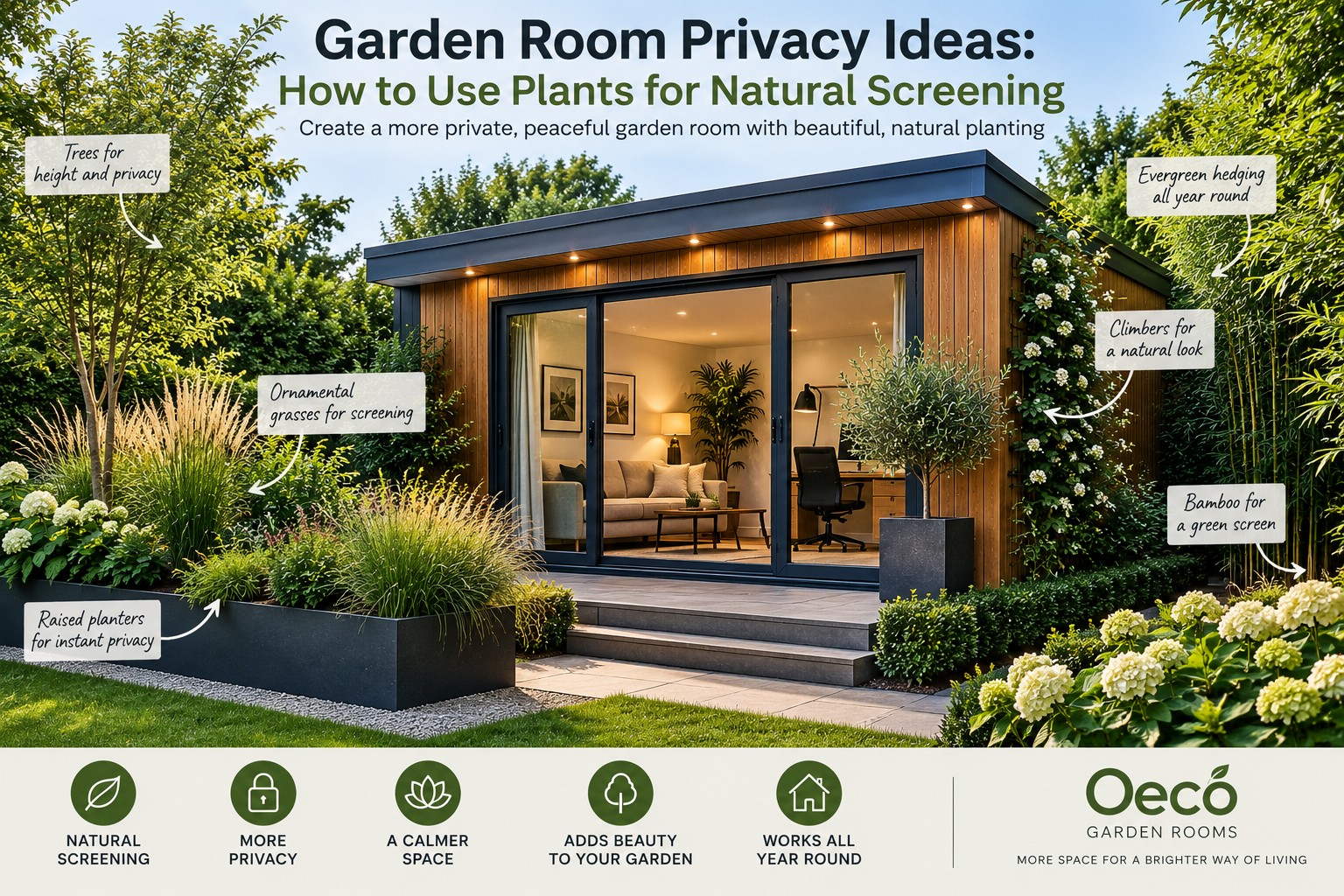
Create a More Private Garden Room With Trees, Hedges, Climbers and Clever Planting
A garden room can provide a wonderfully private place to work, exercise, relax or enjoy hobbies away from the main house. However, large areas of glazing and a position towards the end of the garden can sometimes leave the building more visible to neighbouring properties than you would like.
Fortunately, creating privacy around a garden room doesn't necessarily mean surrounding it with tall fences or solid screens.
Trees, hedges, climbers, ornamental grasses and carefully positioned planters can provide attractive natural screening while helping your garden room blend into the surrounding landscape.
The key is to plan the planting carefully.
You want enough screening to create privacy without making the garden room feel enclosed, blocking valuable natural daylight or positioning plants so close to the building that they interfere with maintenance, ventilation or drainage.
The best garden room privacy planting often combines several different types of plants at different heights rather than relying on one enormous hedge.
Here's how to create a more private, attractive and natural setting around your garden room.
Why Is Privacy Important Around a Garden Room?
Modern garden rooms frequently feature large glazed doors and windows.
This is one of their biggest attractions.
Large areas of glass allow natural daylight into the room and provide excellent views of the garden.
However, glazing works both ways.
Depending on the position of neighbouring houses, fences and windows, people may also be able to see towards your garden room.
Privacy can be particularly important if you're using the building as a:
- Garden office
- Home gym
- Yoga room
- Art studio
- Music room
- Therapy or treatment room
- Relaxation space
- Entertainment room
The objective isn't necessarily to completely hide the building.
Often, simply interrupting direct sightlines can make the interior feel considerably more private.
Start With the Position of Your Garden Room
One of the best opportunities to improve garden room privacy comes before the building is installed.
Consider where the garden room will sit and which direction the main doors and windows will face.
If possible, think about views both from the garden room and towards it.
A small change in orientation could prevent the main glazed elevation from directly facing a neighbour's window.
Existing trees, hedges, fences, walls and outbuildings can also provide useful screening.
Rather than positioning the garden room first and trying to solve privacy afterwards, it is better to consider building position, glazing and landscaping together.
Natural Screening vs Solid Fencing
A tall fence can provide immediate privacy, but it can also make a garden feel smaller or more enclosed.
Planting creates a softer alternative.
Leaves, branches and grasses partially interrupt views while retaining a more natural appearance.
Plants can also move in the wind, change throughout the seasons and provide habitat for wildlife.
In many gardens, the best solution is actually a combination.
A conventional boundary fence provides basic separation, while planting in front softens its appearance and adds additional screening.
This layered approach can look considerably more attractive than simply increasing fence height.
Evergreen Hedges for Garden Room Privacy
If you want year-round garden room privacy, evergreen planting is worth considering.
Deciduous plants can provide excellent screening during spring and summer but lose much of their foliage during winter.
Evergreen hedging retains foliage throughout the year, providing more consistent screening.
The appropriate species depends on factors such as soil, available space, sunlight, desired height and the amount of maintenance you're prepared to undertake.
Remember that a hedge is a living feature.
It needs room to develop and will require maintenance to keep it at an appropriate height and width.
Avoid planting a hedge so close to your garden room that it eventually presses against the cladding or prevents access for maintenance.
Trees for Garden Room Screening
Trees are particularly useful when privacy is required at a higher level.
For example, a fence may block views at ground level but do little to prevent overlooking from first-floor windows.
A carefully positioned tree can help interrupt these higher sightlines.
You don't necessarily need a huge tree.
Smaller ornamental trees and multi-stem specimens can provide foliage at useful heights while also becoming attractive landscape features.
Consider the eventual mature height and spread rather than choosing a tree purely because it looks suitable when young.
A small tree bought from a nursery may eventually become considerably larger.
The root system and distance from buildings, foundations, drains and other structures also need to be considered.
Choose species appropriate for the location and seek professional horticultural advice where necessary.
Multi-Stem Trees Around Garden Rooms
Multi-stem trees can work particularly well in contemporary garden design.
Instead of one dominant trunk, several stems rise from the base, often producing an attractive architectural shape.
Their foliage can provide filtered privacy rather than creating a completely solid barrier.
This is ideal if you want to reduce overlooking without making the garden room feel hidden behind a wall of vegetation.
They can also look particularly effective alongside modern timber or composite garden room cladding.
At night, subtle landscape lighting can turn a multi-stem tree into a feature in its own right.
Ornamental Grasses for Privacy
Tall ornamental grasses are an excellent option for softer garden room screening.
They can add height and movement without the visual weight of a dense hedge.
Planted in groups, grasses can partially obscure views towards glazing and decking while creating a much more natural transition between the garden room and surrounding planting.
They are particularly effective around contemporary garden rooms because their loose, organic appearance contrasts with the clean architectural lines of the building.
Different varieties have very different heights and growing habits, so choose plants appropriate for the available space.
Some grasses die back or require cutting at particular times of year, meaning they shouldn't necessarily be relied upon as your only year-round privacy solution.
Bamboo for Garden Room Privacy
Bamboo is often considered when homeowners want relatively tall, narrow screening.
Its upright form can be particularly useful where space is limited.
However, bamboo needs to be selected carefully.
Some varieties can spread aggressively through underground rhizomes and may become difficult to control.
If bamboo is being considered, investigate whether a clump-forming variety or suitable containerised solution would be more appropriate for your garden.
Large planters can also help create a more controlled bamboo screen.
As with any planting, don't position it directly against the garden room.
Allow appropriate access and space around the building.
Climbers and Trellis Screening
Climbing plants can provide substantial screening without taking up the same ground area as a hedge.
A trellis, pergola or separate screening structure can support climbers and create an attractive green backdrop.
This can be particularly useful beside a garden room seating area or decking.
Rather than attaching climbing plants directly to the garden room cladding, it is generally better to consider a separate support system where appropriate.
This helps maintain access to the building and prevents vegetation from becoming intertwined with parts of the structure.
Flowering climbers can also add colour and seasonal interest while helping create privacy.
Raised Planters for Instant Privacy
One disadvantage of new planting is that it takes time to grow.
Raised planters can help provide more immediate screening.
By raising the planting level, you effectively start with additional height.
A large planter containing suitable shrubs, grasses or bamboo can therefore provide useful screening around a seating area or glazed elevation without waiting years for plants to mature.
Planters also provide flexibility.
Depending on their size and weight, they may be easier to reposition than permanent planting if your garden layout changes.
They work particularly well around decking where conventional planting beds may not be available.
Privacy Around Garden Room Windows
You don't always need to screen the entire garden room.
Sometimes only one particular window creates a privacy problem.
For example, a side window may face towards a neighbouring property while the main glazed doors face into your own garden.
A strategically positioned shrub, small tree or planted screen may solve the problem without changing the rest of the landscaping.
This is why identifying specific sightlines is so important.
Stand where neighbouring windows or pathways are located and consider exactly what can be seen.
Often a relatively small amount of carefully positioned planting can achieve more than a huge hedge in the wrong location.
Don't Block All Your Natural Light
Privacy planting needs to be balanced against daylight.
Large glazed doors and windows are designed to create a bright interior and connect the garden room with the outside.
Planting a dense evergreen hedge immediately in front of them could undermine those benefits.
Instead, try to screen views from particular angles while leaving more open areas where possible.
Filtered screening can often provide sufficient privacy without completely blocking sunlight.
A combination of taller plants at the sides and lower planting directly in front can create privacy while maintaining an open outlook.
Planting Around Garden Room Decking
Decking is often the area where privacy matters most.
You may want to sit outside the garden room with a coffee, entertain friends or work outdoors during warmer weather.
Raised planters positioned around the edge of decking can create an effective transition between private seating and the rest of the garden.
Tall grasses, evergreen shrubs and architectural plants can create enclosure without making the area feel boxed in.
The result can feel more like an outdoor room.
If the garden room includes canopy lighting, carefully selected planting can also look particularly attractive after dark.
Privacy for a Garden Office
Privacy around a garden office isn't only about preventing people seeing inside.
Screening can also reduce visual distractions.
If your desk looks directly towards a busy neighbouring garden, pathway or road, strategically positioned planting can create a calmer outlook.
You can still retain natural daylight and a view of greenery while reducing movement in your peripheral vision.
This can help the garden office feel more separate from everyday activity outside.
Privacy for Garden Gyms
Garden gyms often benefit from additional privacy because occupants may feel uncomfortable exercising in front of large areas of exposed glazing.
Natural screening around the main glazed elevation can make the space feel considerably more private.
You don't necessarily need to completely obscure the glass.
Planting that breaks up direct views may be enough.
Internal blinds can then provide additional privacy when required, particularly after dark when illuminated interiors become easier to see from outside.
Remember Privacy Changes After Dark
A garden room that feels completely private during the daytime can feel very different at night.
During daylight, reflections on the exterior of glazing can make it harder to see inside.
At night, when the garden is dark and the room is illuminated, the interior can become much more visible.
When assessing privacy, therefore, consider both daytime and evening use.
Planting provides some screening, while internal blinds or curtains may offer additional privacy where required.
Exterior landscape lighting should also be positioned carefully so that it enhances the garden without creating excessive glare.
Combining Plants With Garden Screening
Natural planting doesn't have to do all the work.
Contemporary slatted screens, trellis panels, pergolas and fencing can provide structure, while plants soften their appearance.
For example, a timber slatted screen might provide immediate partial privacy, with climbing plants gradually developing around it.
This provides a useful balance between instant screening and long-term natural landscaping.
It can also create a visual connection between timber garden room cladding and other elements around the garden.
Matching Plants With Garden Room Cladding
Think about how planting will look against your chosen external cladding.
Warm Thermowood or Western Red Cedar can look particularly attractive surrounded by deep green foliage.
Charcoal composite creates a strong contemporary backdrop for bright green planting and pale flowers.
Olive-green composite can help the garden room blend more naturally into a heavily planted garden.
Stone-grey finishes work well with softer greens and ornamental grasses.
Planting therefore isn't only about privacy.
It can also enhance the appearance of the garden room itself.
Low-Maintenance Privacy Planting
If you have chosen a low-maintenance garden room exterior, you may not want landscaping that requires constant attention.
Think realistically about how much gardening you enjoy.
Fast-growing plants can create privacy quickly, but rapid growth can also mean frequent pruning.
Slower-growing plants may take longer to establish but require less regular cutting.
Evergreen shrubs, selected grasses and appropriately chosen structural planting can potentially create a relatively manageable scheme.
A garden designer or horticultural professional can recommend species suited to your soil, climate, light levels and desired maintenance.
How Close Should Plants Be to a Garden Room?
Avoid planting directly against the building.
Garden rooms need suitable access around them for inspection and maintenance, and vegetation shouldn't obstruct drainage, ventilation openings or other important building components.
Plants also grow.
A shrub positioned comfortably away from the wall when first planted could eventually spread much further.
Always consider the mature size, not just the size of the plant when purchased.
Trees require additional consideration because their roots and eventual canopy can become substantial.
If you're uncertain, obtain advice appropriate to the plant species and site.
Avoid Creating Damp Conditions
Dense vegetation pressed against a garden room can restrict airflow and retain moisture around the exterior.
That is exactly what good landscaping should avoid.
Leave appropriate space between planting and the building so that air can circulate and the exterior can dry naturally after rainfall.
Don't allow soil, mulch or raised beds to bridge areas of the building that need to remain clear.
Good garden room landscaping should complement the building rather than compromise its construction.
Consider Gutters, Drainage and Roofs
Large trees and shrubs positioned too close to a garden room can increase the amount of leaves and organic material reaching the roof and gutters.
This doesn't mean trees should be avoided.
It simply means their eventual size and position should be considered.
Regular gutter maintenance may be required where deciduous trees overhang or sit close to the building.
Planting shouldn't obstruct drainage routes or make it difficult to inspect the garden room.
Creating Privacy in a Small Garden
Privacy can actually be more challenging in a small garden because neighbouring properties are closer.
The solution isn't necessarily to use the biggest plants available.
Slim planting, climbers, carefully positioned screens and narrow planters can often use limited space more efficiently.
A single well-positioned small tree may interrupt an overlooking window without taking up an entire planting bed.
Vertical planting can also make good use of height where ground area is limited.
In a compact garden, every plant should ideally earn its place by providing privacy, appearance or seasonal interest – preferably more than one.
Layer Your Planting for Better Screening
One of the most effective garden room privacy ideas is to use layered planting.
Instead of one solid hedge, combine different heights and textures.
For example:
A small tree provides upper-level screening.
Evergreen shrubs provide medium-height privacy.
Ornamental grasses soften the foreground.
Lower flowering plants add colour around the base.
Climbers provide vertical coverage against a separate trellis.
This creates a much more interesting landscape while interrupting views at several different heights.
Think About Privacy Throughout the Year
A garden may feel completely private in July and exposed in January.
This happens when the majority of screening comes from deciduous plants.
There's nothing wrong with deciduous planting – seasonal changes are one of the pleasures of a garden.
However, if year-round privacy is important, include some evergreen structure within the design.
A mixture of evergreen and deciduous plants can provide the best of both worlds: reliable screening combined with seasonal colour and interest.
Garden Room Privacy: Plan the Building and Garden Together
The most successful garden rooms don't look as though they have simply been placed onto a lawn.
They feel integrated into the garden.
Privacy planting is an excellent way to achieve this.
Trees can frame the building.
Grasses can soften the edge of decking.
Hedges can screen neighbouring views.
Climbers can add height and colour.
Planters can define seating areas.
Most importantly, planting can make a garden room feel like a genuinely private destination within your garden.
At Oeco Garden Rooms, we believe the position, orientation and appearance of your garden room should be considered alongside how you intend to use the surrounding outdoor space.
Thinking about privacy early can help determine where the building sits, where doors and windows face and how future landscaping could complement the finished design.
The objective isn't necessarily to hide your garden room.
It's to create a comfortable, private setting where the building and garden work naturally together.
10 Benefits of Using Plants for Garden Room Privacy
1. Creates Natural Privacy
Trees, hedges, grasses and shrubs can interrupt sightlines towards your garden room without creating the hard appearance of a solid wall.
2. Makes Your Garden Room Feel More Secluded
Strategically positioned planting can create a stronger sense of separation from neighbouring properties and the main house.
3. Softens the Appearance of the Building
Planting around a garden room helps integrate the structure into the landscape rather than leaving it standing alone on the lawn.
4. Can Provide Year-Round Screening
Evergreen hedges, shrubs and other suitable evergreen plants can maintain privacy throughout winter as well as summer.
5. Adds Colour and Texture
Natural screening can provide flowers, foliage, movement and seasonal interest as well as privacy.
6. Can Screen Higher-Level Views
Trees and taller planting can help interrupt sightlines from upper-storey neighbouring windows that conventional fencing may not address.
7. Enhances Garden Room Decking
Planters and grasses around decking can create a more private outdoor seating area and make the space feel like an extension of the garden room.
8. Can Be Combined With Fencing and Screens
Plants can soften fences, trellis and slatted screens while providing additional privacy as they mature.
9. Provides Flexible Screening
Planters and targeted planting allow you to screen specific windows or viewing angles rather than enclosing the entire garden room.
10. Improves the Overall Garden Design
Well-planned privacy planting doesn't simply hide views – it can transform the garden room into an attractive focal point surrounded by landscaping.
10 Frequently Asked Questions About Garden Room Privacy Planting
1. What are the best plants for privacy around a garden room?
There isn't one plant suitable for every garden.
Evergreen shrubs and hedges can provide year-round screening, while trees can help with higher-level overlooking. Ornamental grasses, bamboo, climbers and plants in raised containers can also provide useful screening.
The best choices depend on soil, sunlight, available space, desired height and how much maintenance you're prepared to undertake.
2. How can I make my garden room more private without a high fence?
Use planting to interrupt direct sightlines.
A combination of small trees, evergreen shrubs, ornamental grasses, climbers and raised planters can provide natural screening without creating the enclosed feeling of a tall solid fence.
A partially open slatted screen combined with planting is another option.
3. What plants provide privacy all year round?
Evergreen plants retain foliage throughout the year and are therefore particularly useful where winter privacy is important.
However, the appropriate species depends on your particular garden and growing conditions.
Combining evergreen structure with deciduous and flowering plants can provide both year-round screening and seasonal interest.
4. Is bamboo good for screening a garden room?
Bamboo can provide tall, relatively narrow screening and can work well in contemporary gardens.
However, some bamboo varieties can spread aggressively.
Research the variety carefully before planting. Clump-forming varieties or bamboo grown in suitable large containers may be easier to control in some situations.
Consider its eventual height and spread and avoid positioning it so close to the garden room that it restricts access or airflow.
5. How close can I plant trees and shrubs to a garden room?
There isn't one distance suitable for every plant because different species have very different mature sizes, root systems and growing habits.
The important point is to plan for the mature plant rather than the size it is when purchased.
Leave sufficient space around the garden room for airflow, drainage, inspection, cleaning and maintenance. Trees require particular consideration because both their roots and canopies can eventually become substantial.
If you're considering larger trees close to a garden room or its foundations, seek appropriate horticultural or arboricultural advice before planting.
6. Can plants cause damp around a garden room?
Poorly positioned planting can contribute to damp conditions if dense vegetation is allowed to grow directly against the exterior.
Plants shouldn't prevent air circulating around the building or obstruct drainage and ventilation.
Soil, compost, mulch and raised planting beds should also be kept appropriately clear of areas of the garden room that need to remain exposed.
Correctly positioned planting can provide excellent privacy without compromising the building.
7. How can I create privacy around garden room decking?
Raised planters are particularly useful around decking because they can provide additional planting height without requiring conventional garden beds.
Tall grasses, evergreen shrubs or suitable bamboo can be used to create partial screening around seating areas.
Trellis or contemporary slatted screens combined with climbing plants are another option.
Rather than completely enclosing the decking, consider screening the specific directions from which the area is overlooked. This can provide privacy while retaining an open feeling and views into your own garden.
8. How can I stop neighbours overlooking my garden room?
Start by identifying exactly where the overlooking occurs.
If the view is from a ground-floor window or neighbouring garden, shrubs, hedging, grasses or screening may be sufficient.
If overlooking comes from an upstairs window, additional height may be required. A strategically positioned small or multi-stem tree can sometimes interrupt the sightline more effectively than simply increasing the height of a boundary fence.
The position and orientation of the garden room itself should also be considered before installation wherever possible.
9. Will privacy planting make my garden room too dark?
It can if planting is positioned too densely or too close to the glazing.
The aim should usually be to interrupt unwanted sightlines rather than completely surround the garden room with dense vegetation.
For example, taller plants can be positioned towards the sides of glazed doors while lower planting is used directly in front.
Filtered screening from trees and grasses can also provide privacy while allowing daylight to pass through.
Consider how the sun moves around your garden before planting large evergreen trees or hedges close to the main glazed elevation.
10. Should I plan garden room privacy before the building is installed?
Yes, whenever possible.
Privacy is much easier to address when the garden room position, orientation, doors, windows and landscaping are considered together.
Think about where neighbouring windows are located and where people can see into your garden.
A relatively small change to the position or orientation of the garden room could reduce overlooking before any screening is required.
You can then use trees, hedges, planters and other landscaping to deal with the remaining sightlines.
Planning privacy from the beginning can create a much more natural result than trying to hide the garden room behind screening after it has been installed.
SEO Details
Recommended Page Title / H1:
Garden Room Privacy Ideas: How to Use Plants for Natural Screening
Recommended Second Heading / H2:
Create a More Private Garden Room With Trees, Hedges, Climbers and Clever Planting
SEO Title Tag:
Garden Room Privacy Ideas Using Plants & Screening | Oeco
Meta Description:
Discover garden room privacy ideas using trees, hedges, grasses, climbers and planters to create attractive natural screening around your garden room.
Recommended URL:/garden-room-privacy-ideas
Recommended Image Filename:garden-room-privacy-planting-ideas.webp
Image Title:
Garden Room Privacy Ideas Using Plants for Natural Screening
Image Alt Text:
Modern garden room with trees, hedges, ornamental grasses and planters providing natural privacy screening
Primary SEO Topic
The primary phrase I would target is:
garden room privacy ideas
The page also naturally covers related searches such as:
garden room privacy
garden room screening ideas
privacy plants for garden rooms
plants for garden privacy
natural garden screening
garden privacy planting ideas
trees for garden privacy
hedges for garden privacy
bamboo screening for garden rooms
ornamental grasses for privacy
how to stop neighbours overlooking a garden room
garden room privacy from neighbours
garden room landscaping ideas
plants around a garden room
garden room decking privacy ideas
These phrases don't need to be repeatedly inserted into the article. The content already discusses the individual subjects in depth and uses closely related terminology naturally.
That is preferable to keyword stuffing because the page remains genuinely useful to someone researching how to create privacy around a garden room, while also giving traditional search engines and AI search systems plenty of context to understand exactly what the article covers.