
Rainwater Harvesting for Garden Rooms: Is It Worth It?
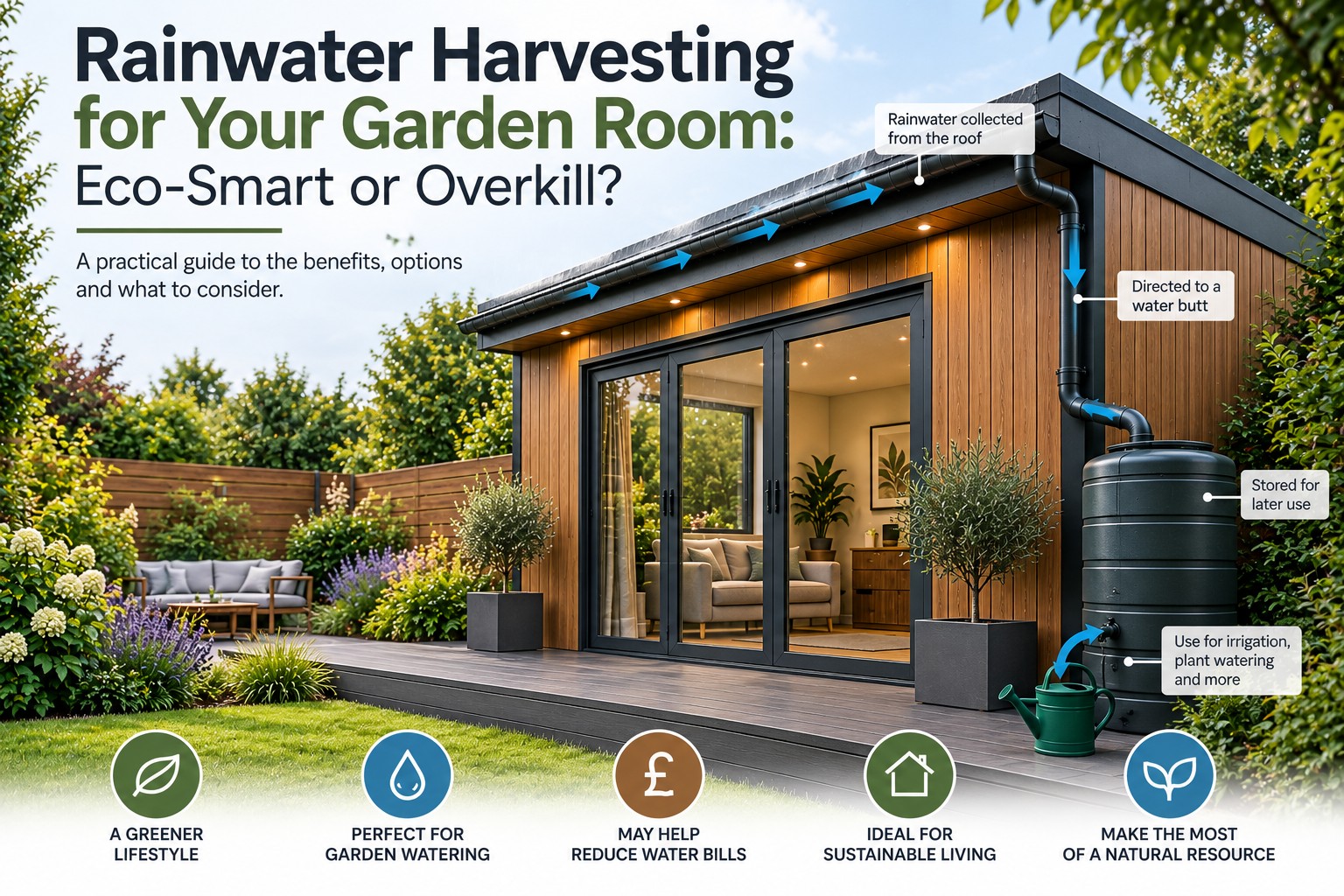
Eco-Smart or Overkill? A Practical Guide to Collecting Rainwater From Your Garden Room
As homeowners look for practical ways to make their homes and gardens more sustainable, rainwater harvesting for garden rooms is becoming an interesting option.
A garden room provides valuable additional space, but its roof can also provide something else: a convenient surface for collecting rainwater.
Rather than allowing rainfall to simply run from the roof and into the drainage system, it can potentially be collected and stored for later use around the garden.
But is installing rainwater harvesting on a garden room genuinely worthwhile, or is it an unnecessary addition?
The answer largely depends on the size of your garden room, how much water you use outdoors and how sophisticated you want the system to be.
For many homeowners, rainwater harvesting doesn't need to mean installing an expensive underground tank, pumps and complicated filtration equipment. A relatively simple guttering system connected to a suitable water butt or storage tank can provide a useful supply of water for plants and general garden use.
For larger properties or homeowners particularly interested in sustainability, more sophisticated rainwater harvesting systems may also be worth considering.
Here's what you need to know.
What Is Rainwater Harvesting?
Rainwater harvesting is simply the process of collecting and storing rainwater so that it can be used later rather than immediately entering a drain or soaking into the ground.
Rainwater usually falls onto a roof, flows into guttering and is directed through a downpipe.
With a harvesting system, some or all of this water is instead directed into a storage container.
The collected water can then potentially be used for purposes such as:
- Watering plants
- Filling watering cans
- Garden irrigation
- Washing garden tools
- Cleaning outdoor furniture
- General outdoor cleaning
More sophisticated systems can potentially supply other non-potable uses, but this requires a considerably more involved installation.
For the average garden room owner, the simplest and most practical solution is normally collecting roof water for use within the garden.
Can You Collect Rainwater From a Garden Room?
In principle, yes.
A garden room roof creates a useful rainwater catchment area.
Rain falling onto the roof can be directed towards guttering and a downpipe, where a rainwater diverter can channel water into a water butt or larger storage tank.
The amount you could potentially collect depends primarily on two things:
the roof area and the amount of rainfall.
As a simple theoretical example, 1mm of rain falling onto 1m² of roof represents approximately one litre of water before allowing for losses.
So if a garden room had a roof area of 20m², 10mm of rainfall would represent roughly 200 litres falling onto that roof.
You won't necessarily capture every litre. Some water can be lost through splash, overflow and the efficiency of the collection system.
Nevertheless, it demonstrates how even a relatively modest garden room roof can provide a useful rainwater collection area.
Why Use a Garden Room for Rainwater Harvesting?
One advantage is simply location.
Garden rooms are normally positioned within the garden – exactly where stored rainwater is likely to be most useful.
Rather than carrying watering cans from the house or repeatedly using an outside tap, collected rainwater can potentially be stored close to flower beds, planters and landscaped areas.
The garden room roof is already there, so the main task is capturing water that would otherwise run away.
For homeowners who have invested significantly in landscaping around their new garden room, this can make particularly good sense.
A Water Butt May Be All You Need
The phrase "rainwater harvesting system" can make the idea sound far more complicated than it needs to be.
For many homeowners, a water butt connected to the garden room guttering could be sufficient.
Rainwater flows from the roof into the gutter and downpipe. A diverter then directs water into the storage container.
Once the water butt is full, a correctly arranged system can direct excess water towards the appropriate drainage route.
A tap near the bottom of the container allows a watering can to be filled whenever required.
It is simple, relatively unobtrusive and doesn't require a complicated mechanical system.
This is likely to be the most practical starting point for many garden room owners.
Choosing the Right Size of Water Butt
There is little benefit in installing an enormous tank if you only have a small garden and occasionally water a few pots.
Equally, a very small water butt could fill rapidly when connected to a large garden room roof.
Think about how you actually use water.
A smaller storage container may be perfectly adequate for:
- Window boxes
- Pots
- Small flower beds
- Occasional watering
A larger capacity may make more sense if you have:
- Extensive planting
- Raised beds
- A vegetable garden
- Greenhouses
- Large numbers of planters
- Regular irrigation requirements
It is about matching storage capacity with both the available roof catchment and your likely demand.
Rainwater Harvesting and Garden Irrigation
Garden watering is one of the most obvious uses for harvested rainwater.
During warmer and drier periods, gardens can require substantial quantities of water.
If stored rainwater is available, you may be able to use this before turning to mains water.
A basic arrangement could simply involve filling a watering can from a water butt.
Larger systems can potentially be connected to appropriate irrigation equipment, depending on the design, pressure requirements and filtration needed.
The simplest system is often the most attractive because it requires little maintenance and is easy to understand.
Could Rainwater Harvesting Reduce Your Water Bill?
Potentially – but it depends on how your water charges are calculated and how much mains water you currently use outdoors.
If your property has a water meter, reducing mains water consumption can potentially reduce the amount you pay for water.
However, installing a rainwater harvesting system purely as a money-saving exercise may not always produce a rapid financial return.
A straightforward water butt and diverter is relatively simple.
An elaborate system involving underground tanks, pumps, filters and plumbing represents a much greater investment.
For most garden room owners, the environmental and practical benefits may be more compelling than expecting substantial immediate financial savings.
Is Rainwater Better for Plants?
Rainwater is commonly used for garden watering and has the obvious advantage of being freely available when captured and stored appropriately.
Using harvested rainwater also reduces the need to use treated mains drinking water for jobs that don't require drinking-quality water.
For many homeowners, that is the most logical reason for harvesting it.
We invest considerable resources in producing and supplying high-quality mains water. Using that water to irrigate flower beds while rainwater runs from a garden room roof into a drain can seem unnecessarily wasteful when a simple collection solution is available.
Making a Garden Room More Sustainable
Sustainability in garden room construction shouldn't be judged by one individual feature.
A more useful approach is to look at the building as a whole.
Factors can include:
- Insulation
- Timber and construction materials
- Durable external cladding
- Energy-efficient glazing
- Heating requirements
- LED lighting
- Building longevity
- Responsible material choices
- Rainwater management
Rainwater harvesting can complement these features.
It won't transform a poorly designed building into an environmentally friendly one, but it can form part of a wider approach to reducing resource consumption.
Does Rainwater Harvesting Help With Drainage?
Potentially, although it shouldn't be treated as a replacement for a properly designed drainage solution.
When rain falls heavily onto a roof, water has to go somewhere.
Temporarily capturing some of that water in a storage tank can reduce the amount immediately leaving the roof.
However, once the storage container is full, additional rainfall needs a safe overflow route.
This is particularly important during prolonged or heavy rainfall.
A water butt should therefore form part of a properly considered rainwater arrangement rather than simply having a downpipe inserted into a container with nowhere for overflow to go.
What Happens When the Water Butt Is Full?
This is one of the most important practical considerations.
During periods of frequent rain, a water butt can fill surprisingly quickly.
Once full, excess rainwater must be safely directed away.
Many rainwater diverters are designed so that when the storage container reaches capacity, excess water continues through the downpipe towards the normal drainage destination.
The exact solution will depend on the garden room, site and drainage arrangement.
The important principle is that excess water shouldn't simply overflow next to the building.
Where Should the Water Butt Be Positioned?
Ideally, the storage container should be conveniently positioned close to the downpipe while remaining visually acceptable within the overall garden design.
It also needs a stable and suitable base.
Remember that water is heavy.
One litre of water weighs approximately one kilogram, so a 250-litre container could hold roughly 250kg of water before considering the weight of the tank itself.
Larger storage tanks can therefore become extremely heavy when full.
The supporting surface and installation need to be appropriate for the size of the container.
Can You Hide a Rainwater Tank?
Yes, and this may be important if you have invested in a premium landscaped garden.
Traditional water butts aren't the only option.
Modern storage containers are available in a variety of shapes and styles, including slimline designs that can sit relatively discreetly beside a building.
Depending on the garden design, a tank might also be screened by suitable planting or landscaping, provided access and ventilation aren't compromised.
Another option is to deliberately make the water storage part of the garden design.
The objective should be to combine practicality with appearance rather than adding an unattractive container as an afterthought.
Do You Need a Pump?
For simple garden watering, often not.
A tap positioned towards the bottom of an elevated water butt can allow you to fill a watering can using gravity.
A pump becomes more relevant where water needs to be moved further, delivered at greater pressure or supplied to certain irrigation systems.
Pumps add complexity, cost, energy consumption and maintenance.
This illustrates why it is worth deciding what you actually want the harvested water to do before choosing a system.
If your objective is simply to water plants around your garden room, the simplest solution may be the best.
Does Harvested Rainwater Need Filtering?
Some form of debris management is sensible.
Leaves, moss and other material can enter roof drainage systems, which is why gutters need periodic cleaning.
Depending on the system, filters or screens can help prevent larger debris from entering the storage container.
More sophisticated uses of harvested water require more sophisticated treatment and system design.
For straightforward garden irrigation, the objective is generally to keep obvious debris out and maintain the storage system appropriately.
Stored rainwater shouldn't automatically be assumed to be suitable for drinking.
What Maintenance Is Required?
A simple rainwater collection system shouldn't require excessive maintenance, but it shouldn't be ignored either.
Periodically check:
- Gutters
- Downpipes
- Diverters
- Filters
- Tank lids
- Overflow routes
- Taps and connections
Remove accumulated leaves and debris where necessary.
The tank should be appropriately covered to reduce contamination and prevent unwanted material entering.
A few simple checks can help keep the system working effectively.
What About Winter?
Rainwater harvesting systems need to cope with seasonal conditions.
Freezing temperatures can affect exposed water, pipework, taps and containers.
The requirements will vary according to the system being installed, so the manufacturer's guidance should be followed regarding frost protection, winter operation and maintenance.
This is particularly important for pumps or more complex equipment.
Again, simplicity has advantages.
The fewer mechanical components involved, the less there generally is to maintain.
Simple System vs Full Rainwater Harvesting System
There is an enormous difference between collecting rainwater in a water butt and installing a whole-property rainwater harvesting system.
A simple garden room setup might consist of:
Roof → gutter → downpipe → diverter → water butt → watering can.
A sophisticated system could involve:
Roof → filtration → large storage tank → pump → controls → dedicated non-potable plumbing.
Both could technically be described as rainwater harvesting, but they solve very different problems.
For a typical domestic garden room, the simple version is likely to provide the most accessible benefits.
Is an Underground Rainwater Tank Worth Considering?
Possibly, but usually only where there is sufficient demand to justify it.
An underground system has the advantage of storing considerably larger quantities of water without a large visible tank.
However, excavation, tank installation, filtration, pumps and associated plumbing can substantially increase the complexity and cost.
If you are already undertaking extensive landscaping or construction work, incorporating a larger system at that stage may be easier than adding one afterwards.
For somebody who simply wants free water for a few flower beds, however, it would probably be unnecessarily complicated.
Should Rainwater Harvesting Be Planned With the Garden Room?
If you know that you want to collect rainwater, it makes sense to consider it during the garden room planning stage.
You can think about:
- Guttering
- Downpipe location
- Tank position
- Overflow
- Access
- Landscaping
- Screening
- Irrigation
- Drainage
Planning these elements together can produce a neater finished result.
It also avoids installing a beautiful garden room and then discovering that the only practical position for a large water butt is somewhere highly visible.
Rainwater Harvesting: Eco-Smart or Overkill?
For most garden room owners, collecting some rainwater is a sensible idea – but the system doesn't need to be complicated.
A garden room already provides the roof catchment area.
Adding suitable guttering, a diverter and a water butt can create a straightforward source of water for the surrounding garden.
It can reduce reliance on treated mains water for garden watering and make use of a natural resource that would otherwise simply drain away.
Where rainwater harvesting starts becoming "overkill" is when the complexity and cost of the system become disproportionate to the amount of water you are actually going to use.
There is little point installing a sophisticated underground tank and pumping system if you have a small garden and only use two watering cans each week.
Conversely, a large garden with extensive planting, vegetable beds or irrigation requirements may justify considerably greater storage.
Is Rainwater Harvesting for a Garden Room Worth It?
For many homeowners, yes – particularly when it is kept simple and matched to how the garden is actually used.
The garden room roof is already collecting rain every time it rains. The question is whether you allow all that water to run away or capture some of it for later.
A simple water butt can be inexpensive compared with many garden improvements, requires relatively little maintenance and provides a useful supply of water exactly where you need it.
Larger systems require more careful consideration.
The best approach isn't necessarily to collect as much water as physically possible.
It is to create a system that matches your garden, your water usage and your budget.
At Oeco Garden Rooms, we believe good garden room design extends beyond the building itself. Considering how the garden room interacts with landscaping, drainage and the wider garden can help create an outdoor space that works as one complete environment.
Rainwater harvesting is a good example.
It may be a relatively small addition, but when designed appropriately it can turn the roof of your garden room into a useful source of water for the garden surrounding it.
10 Benefits of Rainwater Harvesting for Garden Rooms
-
Makes Use of Naturally Available Rainwater
Instead of allowing all the rain falling onto your garden room roof to drain away, some can be captured and stored for later use. -
Ideal for Watering the Garden
Stored rainwater can provide a convenient supply for flower beds, pots, planters, raised beds and other landscaped areas. -
Reduces Reliance on Mains Water
Using harvested rainwater for suitable outdoor jobs means less treated drinking-quality water is required for garden watering. -
Could Help Reduce Metered Water Usage
For households with metered water, reducing mains water consumption may help reduce water charges, depending on individual usage and tariff arrangements. -
Can Be Simple to Implement
Rainwater harvesting doesn't necessarily require an expensive underground system. A suitable water butt connected to the garden room guttering may be sufficient. -
Water Is Available Close to the Garden
Because the tank is positioned around the garden room, water can be stored close to the plants and landscaped areas where it is needed. -
Complements Sustainable Garden Design
Rainwater collection can work alongside efficient insulation, durable materials and other environmentally considered garden room features. -
Can Temporarily Hold Some Roof Run-Off
Storage can retain a quantity of rainfall rather than allowing all roof water to leave immediately, although appropriate overflow and drainage remain essential. -
Systems Can Be Scaled to Suit the Garden
From a compact water butt to a larger storage system, rainwater harvesting can be matched to the roof size, available space and likely water demand. -
Makes Your Garden Room Work Harder
Your garden room provides useful internal space while its roof can simultaneously act as a rainwater catchment area.
Frequently Asked Questions About Garden Room Rainwater Harvesting
1. Can I collect rainwater from my garden room roof?
Yes. Rainwater falling onto a suitable garden room roof can be directed through guttering and downpipes into an appropriate storage system. The precise arrangement should take account of the roof design, drainage and safe overflow requirements.
2. How much rainwater can I collect from a garden room?
The amount depends mainly on roof area, rainfall and collection efficiency. As a simple theoretical calculation, 1mm of rainfall across 1m² of roof represents approximately one litre of water before collection losses. A 20m² roof receiving 10mm of rain therefore receives roughly 200 litres of rainfall.
3. Do I need an expensive rainwater harvesting system?
Not necessarily. For many garden room owners, a water butt connected to a downpipe with a suitable rainwater diverter may provide all the storage required for ordinary garden watering.
4. What can I use harvested rainwater for?
The simplest use is watering plants, flower beds, pots and planters. It can also be useful for appropriate outdoor cleaning tasks. More sophisticated non-potable uses require correctly designed systems, plumbing, filtration and controls.
5. Can I drink rainwater collected from my garden room?
Water collected from a roof and stored in a basic water butt shouldn't automatically be considered safe drinking water. Potable use requires appropriate treatment and a system specifically designed for that purpose.
6. Will a rainwater harvesting system reduce my water bills?
It can reduce your consumption of mains water for suitable uses. Whether that translates into financial savings depends particularly on whether your water supply is metered, how much water you use and the cost of installing the collection system.
7. What happens when the water butt is full?
A properly arranged system needs a safe overflow route. Many diverters allow excess water to continue through the normal downpipe once the storage container is full. Water shouldn't simply be allowed to overflow around the base of the garden room.
8. What size water butt do I need for a garden room?
The best size depends on the roof area of your garden room, the amount of rainfall you receive, available space and how much stored water you are likely to use.
For a smaller garden with pots and flower beds, a compact water butt may be perfectly adequate. If you have a larger garden, extensive planting, raised beds or regular irrigation requirements, a larger storage tank could be more useful.
Remember that even a relatively modest garden room roof can collect a surprising amount of water during heavy rainfall, so it is worth considering both storage capacity and a suitable overflow arrangement.
9. Does a rainwater harvesting system need a pump?
Not always. If you simply want to fill a watering can from a water butt, gravity may be sufficient, particularly if the tank is positioned on a suitable raised base.
A pump may be required if you want to move the water over greater distances or connect the storage tank to certain irrigation systems.
Before adding pumps and additional equipment, consider how you actually intend to use the water. For many homeowners, a straightforward gravity-fed system will be simpler, cheaper and easier to maintain.
10. Is rainwater harvesting worth adding to a garden room?
For many homeowners, yes – particularly if the system is kept simple.
A garden room already provides a useful roof catchment area, so adding guttering, a downpipe, diverter and appropriately sized water butt can provide a convenient supply of rainwater for the surrounding garden.
Whether a larger and more sophisticated rainwater harvesting system is worthwhile depends on the size of the garden, the amount of water you use and your budget.
The key is to match the system to your actual requirements rather than making it unnecessarily complicated.